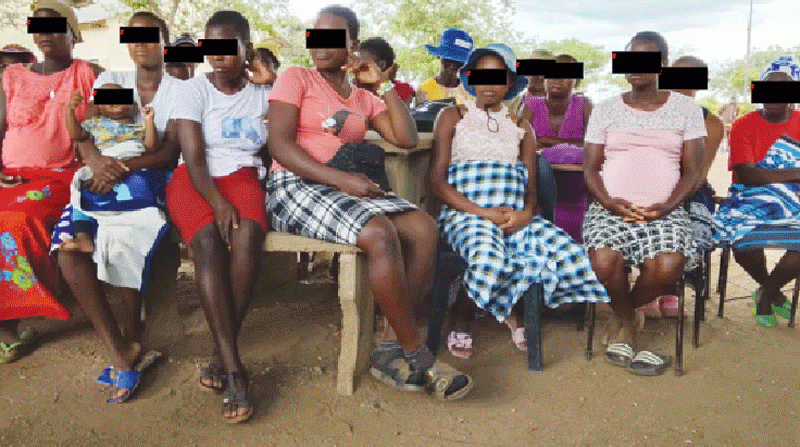
THE stories of teen mothers in Chipinge district, Manicaland province, are not merely tragic human-interest accounts; they are an indictment of a society that has normalised the abandonment of its children.
NewsDay reported on Saturday on girls who were driven into sex work to fend for their families. Sixteen-year-old Chipo has had four pregnancies.
Fifteen-year-old Privilege has become a breadwinner for her aunt and two younger siblings after their parents passed away several years ago.
These girls have been forced into sex work to escape poverty, which has not only stripped them of opportunities, but also robbed them of childhood, dignity and safety.
Chipo and Privilege did not fail. Society did.
Where is society when a 15-year-old girl is forced into sex work to keep her family alive? Where are the institutions meant to protect children when hunger dictates behaviour and exploitation becomes inevitable?
We have failed the girl child.
Statistics show that 1 in 3 girls in Zimbabwe are married off before the age of 18; nearly 1 in 4 of all school dropouts are due to pregnancy or marriage, while 65,9% of girls complete secondary school, with even lower rates in rural districts like Chipinge.
- Chipinge suffers brunt of human wildlife conflict
- Chipinge suffers brunt of human wildlife conflict
- Information key to climate change mitigation: FAO
- Pupil commits suicide over satanism taunt
Keep Reading
Tied to this is the rampant abuse of girls married off to old people, some qualifying to be their grandfathers, especially among the apostolic sects.
The laws are there that have prescribed the age of consent at 18 years. However, the laws that protect the girl child have largely been ignored, giving some apostolic sect members carte blanche to take child brides.
The death of Memory Machaya — a 14-year-old who died during childbirth at a church shrine in Marange in 2021 — should have jolted the nation into decisive action.
Instead, Zimbabwe continues to grapple with teenage pregnancies and child brides, proof of a society that has chosen to look away.
This is not accidental. It is structural neglect.
Broken social protection systems, collapsing livelihoods, weak child-welfare mechanisms and an education system that loses girls long before they can secure their futures have created fertile ground for exploitation.
While programmes such as those championed by the Organisation of African First Ladies on Development have provided critical relief in Chipinge, there is no substitute for a comprehensive national response.
A US$10 monthly stipend, while helpful, is no solution to entrenched poverty. It is like a bandage on a deep wound.
The eradication of poverty is the only way to stem exploitation. Hunger must never be allowed to dictate behaviour.
Institutions meant to protect children must not be bystanders. They need to speak out against such evil.
They must never tire in their efforts to protect children. The church must also flag abuses of children.
Early pregnancies, unsafe abortions and child-headed households do not happen in isolation.
They occur in full view of communities, schools, churches and authorities who too often respond only after lives have been permanently altered.
If Zimbabwe is serious about safeguarding its future, it must start by protecting its girls.
This is done through expanding social safety nets, guaranteeing access to education for pregnant girls and young mothers, strengthening child protection laws and providing meaningful economic opportunities for vulnerable families.
It must also confront uncomfortable realities about poverty and inequality.
Zimbabweans must put all hands on deck to fight poverty, lest stories like those of Chipo and Privilege will continue to surface —evidence of a nation failing its most vulnerable.