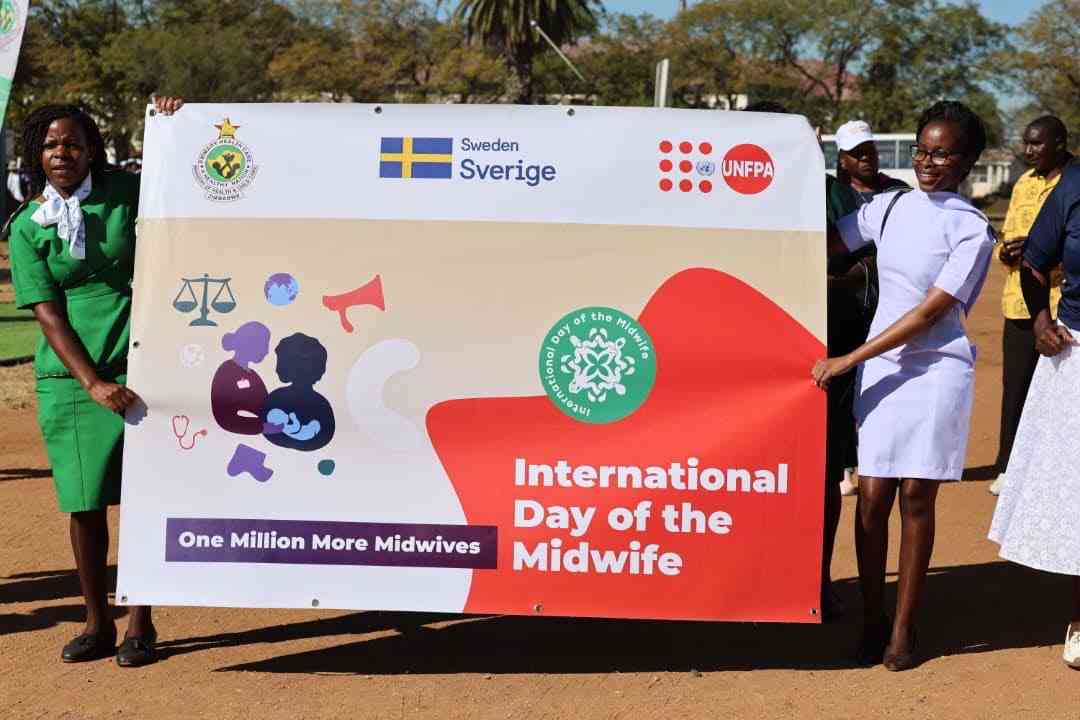
The United Nations Population Fund (UNFPA), the Ministry of Health and Child Care, the Embassy of Sweden and the Zimbabwe Confederation of Midwives (ZICOM) marked the 2026 International Day of the Midwife at United Bulawayo Hospitals, calling for increased investment in midwifery to improve maternal and newborn health outcomes.
Commemorated under the theme “One Million More Midwives,” the event highlighted the global shortage of skilled midwives and the urgent need to strengthen the profession. The International Confederation of Midwives says closing the workforce gap is critical to ensuring safe, quality maternal and newborn care by 2035.
Midwives can provide up to 90% of essential sexual and reproductive health services when adequately trained and supported, making them central to efforts to reduce maternal and newborn deaths.
In remarks delivered on his behalf, Health and Child Care Minister Douglas Mombeshora said the government remains committed to strengthening the profession through increased investment in training, retention and remuneration.
“Midwives are the backbone of our maternal and newborn health system,” Mombeshora said.
“We are committed to increasing investment in training, fair compensation and retention of midwives as part of our strategy to end preventable maternal deaths and ensure safer motherhood for every woman and newborn in Zimbabwe.”
UNFPA representative Miranda Tabifor said investment in midwifery is one of the most cost-effective ways to improve maternal and newborn health, noting that every US$1 invested can generate up to US$16 in social and economic returns.
She said UNFPA continues to support the ministry through pre-service and in-service training programmes funded under initiatives such as the Health Resilience Fund and the Maternal and Newborn Fund.
- SAYWHAT’s peer education arm touches young girls
- Child marriage: A heavy cost for young girls in Africa
- Child marriage comes with a heavy cost
- Zanu PF old guard retain CC posts
Keep Reading
The Health Resilience Fund is supported by Britain, Ireland and Sweden.
A key feature of the commemorations was the showcase of digital health innovations, including the electronic partograph, which enables real-time monitoring of mothers and babies during labour and supports faster clinical decision-making.
The event ended with the Midwives Recognition Initiative, supported by the Embassy of Sweden, which honoured outstanding midwives from all 10 provinces for exceptional service under often challenging conditions.
“We are honoured to support the recognition of outstanding midwives,” Swedish Ambassador to Zimbabwe Per Lingarde said.
“We hope this gesture will motivate midwives to continue delivering quality care. We also urge the Government of Zimbabwe and its partners to invest more in the training, fair compensation and retention of midwives and other healthcare workers.”