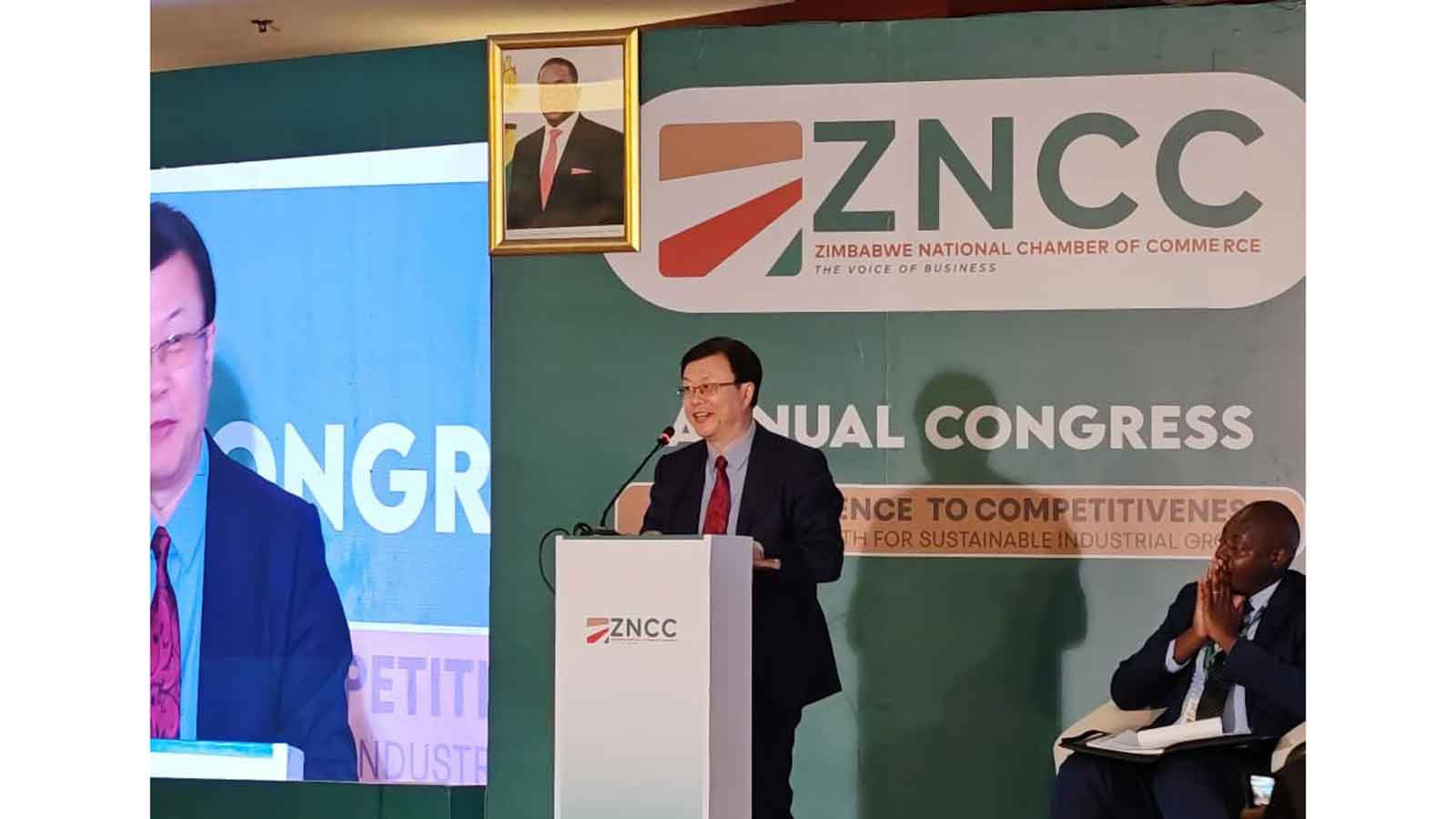
Addressing the 2026 ZNCC Annual Congress in Victoria Falls, Chinese ambassador Zhou Ding outlined a transformative era for bilateral relations. With trade hitting record highs, a landmark zero-tariff policy now promises to accelerate Zimbabwe’s industrialisation and shift its exports toward higher-value goods. Below is the full speech.
It is a profound honour to join you at the 2026 ZNCC Annual Congress. Allow me to begin by extending my warmest congratulations to the Zimbabwe National Chamber of Commerce and to all its valued members.
I commend ZNCC for its vital, unique role in advancing Zimbabwe's economic transformation, facilitating robust business-to-business and business-to-government dialogues, and nurturing economic and trade ties between China and Zimbabwe.
Given that a number of Chinese enterprises are proud members of this organiSation, I call upon them to deepen their engagement and redouble their efforts to support the continued growth of this crucial institution.
Today, I would like to share my observations on three key dimensions: the current landscape of China-Zimbabwe bilateral economic and trade relations, the transformative opportunities presented by China's new zero-tariff policy, and the way forward for our cooperation.
China and Zimbabwe share a long-standing all-weather friendship, and our economic and trade relations have served as a cornerstone of this great partnership.
China has long been Zimbabwe’s biggest source of foreign direct investment, with cumulative inflows reaching approximately US$10 billion across sectors such as steel, cement, fertiliser, building materials, mineral processing, power stations, and digital infrastructure.
These investments are transforming Zimbabwe's economic landscape—building industrial supply chains, bolstering local manufacturing capacity, and generating substantial employment and tax revenues.
- China pledges more support for Zimbabwe as trade partnership strengthens
- China celebrates birth of its army
- China boosts Zim’s fight against drug abuse
- China supports Zim’s HR development plans
Keep Reading
On the trade front, we are witnessing historic and rapid growth. According to Chinese customs statistics, bilateral trade hit US$4.4 billion in 2025, marking a year-on-year increase of 15.2% and reaching a new historic high.
Zimbabwe's exports to China stood at US$2.57 billion, while imports from China totaled US$1.83 billion, securing a trade surplus of US740 million for Zimbabwe.
What is particularly encouraging is the growing diversification of our trade relationship. While traditional exports such as minerals and tobacco remain significant, new growth areas are emerging.
Agricultural and horticultural products—including macadamia nuts, citrus fruits, avocados, and blueberries—are now entering the vast Chinese market.
At the same time, imports of more advanced machinery, solar equipment, and electronics are further enhancing Zimbabwe's manufacturing sector, lowering the cost of doing business, and improving people's livelihoods.
This year marks an important milestone in China-Zimbabwe trade relations. Effective 1 May 2026, China has granted zero-tariff treatment to 53 African countries with which it has diplomatic relations, including Zimbabwe.
This is one of the most comprehensive and significant unilateral market-opening measures ever extended to Africa, and it reflects China's firm commitment to high-level opening-up, South-South cooperation, and the building of an all-weather China-Africa community with a shared future for the new era.
For Zimbabwe, this policy unlocks tremendous opportunities—particularly for its business community. With tariffs eliminated, Zimbabwean products can access the Chinese market at lower cost and with greater price competitiveness.
The policy will also stimulate export diversification, encourage greater investment in value addition, and propel Zimbabwe's transition from raw material exporter to higher-value product supplier—thereby strengthening economic resilience and enhancing its capacity for independent and sustainable development.
Above all, this policy links China's vast market with Zimbabwe's rich development potential, creating a partnership that advances Zimbabwe's industrialisation and modernisation while contributing to our shared prosperity.
China's zero-tariff policy represents an unprecedented institutional dividend for our economic and trade cooperation. However, translating this policy advantage into tangible economic returns requires our collective and concerted efforts. To maximise its benefits, we need to take action in the following areas.
First, we must enhance market access support and strengthen trade facilitation. Our embassy, relevant ministries, and export promotion agencies need to intensify information sharing, guidance, and training for local exporters on China's market access requirements, certifications of origin, and customs clearance procedures.
In this regard, we count on ZNCC and ZimTrade to play a pivotal role by organizing buyer-seller matchmaking events, trade fairs, and business delegation exchanges.
These efforts will help connect Chinese importers with Zimbabwean producers and exporters, secure more purchase orders, and particularly boost the export of premium agricultural and horticultural products.
Second, we must place strategic emphasis on boosting Zimbabwe's production capacity and moving up the value chain. We need to channel fresh investment and deploy state-of-the-art equipment and technologies to unlock new levels of productivity. In alignment with the Zimbabwean government's NDS2, I call on Chinese enterprises to invest in integrated industrial parks that fuse manufacturing, logistics, and trade—extending Zimbabwe's industrial reach, driving higher value addition, and propelling Zimbabwean products into lucrative Chinese markets.
Third, we must pursue deeper policy coordination, closer institutional connectivity, and broader financial cooperation. Both sides should expedite negotiations on the China-Zimbabwe Economic Partnership for Shared Development Agreement, aiming to secure a stable and enduring framework for our bilateral trade and investment flows.
I call upon Zimbabwean enterprises to fully leverage key platforms—including the China International Import Expo, the China-Africa Economic and Trade Expo, and cross-border e-commerce channels—to tap into the vast opportunities offered by the zero-tariff policy.
On the financial front, we should utilize a wider array of trade financing instruments, and upgrade and optimise cross-border payment systems—all with the goal of lowering transaction costs and sharpening operational efficiency.
Fourth, we must continue our efforts to address infrastructure constraints and break development bottlenecks. To enhance value addition, we need a more reliable and stable transport system, power supply, and telecommunications network.
Through Chinese government concessional loans, we have built key infrastructure projects, including the expansion of Hwange and Kariba South power stations, the upgrading of Harare and Victoria Falls airports, and the modernization of TelOne and NetOne networks.
We are also pleased that Chinese investors are building captive power plants with a combined capacity exceeding 1 000 megawatts. Nevertheless, we still face high logistics costs.
Infrastructure constraints—including electricity, water, roads, and railways—continue to hamper Zimbabwe's full industrial and agricultural capacity.
We applaud the Zimbabwean government's clear vision and relentless efforts to strengthen infrastructure, enhance industrial competitiveness, attract investment for value addition, and fulfill its export potential.
Trade and investment relations are a long-term commitment. As Zimbabwe champions the mantra of "Open for Business", we support every effort by the Zimbabwean government to strengthen financial and monetary stability, enhance the predictability, consistency, and transparency of its industrial and investment policies, and create a more stable, competitive, and investor-friendly business environment.
These are key to attracting long-term investment and unlocking Zimbabwe's enormous industrial potential. As Zimbabwe's strategic partner and all-weather friend, China is committed to standing firm with Zimbabwe and making continuous contributions.
We will continue to encourage Chinese enterprises to invest in Zimbabwe, based on win-win principles, market rules, and our enduring traditional friendship. I am confident that our joint efforts will bring more tangible benefits to Zimbabwe and its people.
Finally, I wish the 2026 ZNCC Annual Congress a great success. May the Zimbabwean business community continue to thrive, and may Zimbabwe enjoy enduring peace and greater prosperity.
- Zhou is China’s embassador to Zimbabwe. He delivered this speech at the the 2026 ZNCC Annual Congress in Victoria Falls on June 25.