For years, women in Binga’s Saba area watched their lives revolve around waiting — waiting for husbands to return from fishing trips or piece jobs, waiting for money that was never enough, and waiting for a chance to change their circumstances.
That chance came through a vocational training programme implemented under the Climate Adaptation, Water and Energy Programme (Cawep), a g0overnment initiative supported by the United Nations Development Programme (UNDP) and the Foreign, Commonwealth and Development Office (FCDO).
The programme trained 207 youths in Saba area under Chief Saba, equipping them with practical skills in cutting and design (sewing), welding, building, cosmetology and solar installation — skills that are now translating into income, dignity and self-reliance.
Women beneficiaries said before the programme, many spent their days at home with no source of income, depending on money earned by their husbands, which was often insufficient to meet basic household needs such as food and school fees.
One of the beneficiaries, Elie Mudhimba (32), said the training marked a turning point in her life.
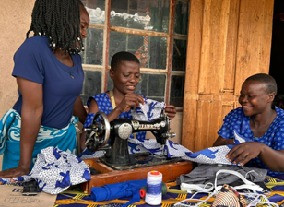
“Before this training I used to stay at home doing nothing and when this programme came I was empowered,” Mudhimbasaid
“I was trained in cutting and design and building and now I can make clothes for myself and my children and some for sale. I am now able to take care of my family and my parents.”
- R. Kelly sentenced to 30 years in sex trafficking case
- In Full: sixteenth post-cabinet press briefing June 14, 2022
- New-look Beitbridge border impresses financiers
- Abwa commissions milk plant
Keep Reading
Beyond improving her own livelihood, Mudhimba said the training had placed her in a position to uplift others.
“I would like to thank Government through UNDP’s Cawep as it has empowered us as youth in Binga.
“Now I am training other youths who did not qualify and other adults on how to sew clothes and earn money to take care of their families,” she said.
Her impact is already visible in the community.
One of her trainees, Fatima Sibanda (33), said she was grateful for the opportunity and committed to passing on the skills to other women.
Another trainee, Elizabeth Muleya, said the training would help her better provide for her family and reduce dependency.
For Prisca Munsaka (29), the programme expanded an existing business into a more sustainable livelihood.
Trained in cosmetology, she said the new skills enhanced her income-generating activities.
“I used to do braiding and weaving before I was taught to do cosmetology.
“Now I can do make-ups, manicure and pedicure which has enhanced my business,” said Munsaka.
She said business management training was equally transformative.
“I was also taught business management skills so now I can properly manage my business and I hope to expand it and earn more money so that I can take care of my family,” she said.
“This training in cosmetology has enhanced my skills in the beauty industry and I hope to spread it in Binga.”
Youth involved in technical trades said the programme moved them from survival work to skilled production.
Welder Khumbulani Muleya said the training fundamentally changed the way he worked.
“Before the training I used to join and seal people’s broken products and get US$10-$15 but now I can make my own products like door and window frames, push and scotch carts which cost US$600 and steel boats which cost US$500, among others,” he said.
“I was an amateur, but now I see myself as a pro in the game
“This training has empowered not only me but other youths in Binga and now we can make our own money through our newly acquired skills.”
Muleya said he was now training young boys in welding and hopes to expand his business to other communities.
“I would like to thank Government for this project as it has empowered youths in this community,” he said.
The programme also supported entrepreneurship through access to loans. Joyce Mwembe (44) said financial and business management support enabled her to grow her business into a fully established shop.
“I started buying things for sale going from one place to another before I built my shop in 2023,” Mwembe said.
“I was given a loan of US$2 000, which I used to boost my business.
“I was also trained in business management and I managed to develop and expand my business.
“Now I am a proud owner of a shop. I would like to thank UNDP for this project as it has greatly improved my life as a shop owner,” she said.
Steven Muleya (32), who received training in solar panel installation, said the programme diversified his skills, although access to equipment remains a challenge.
“I used to do cell phone repairs before I was trained on solar panel installation.
“The challenge I am having is that in as much as I was taught to install solar systems, I do not have the equipment to do the job. I was also trained in business management skills and I hope they will help in enhancing my business,” he said.
Traditional leader Chief Saba (Charles Mudenda) said the skills training programme had brought positive change to the community, particularly among young people.
“This has made them stay away from drug and substance abuse, though cases are rare in my community,” Chief Mudenda noted.
“They have gained skills which will enable them to work for themselves and make a living out of it.”
He urged beneficiaries to continue sharing their skills with others.
“I urge them to continue cascading their skills to other youths so that they empower each other.
“I am happy with the skills training project and hope the youth will take it seriously as it can transform my community,” he said.