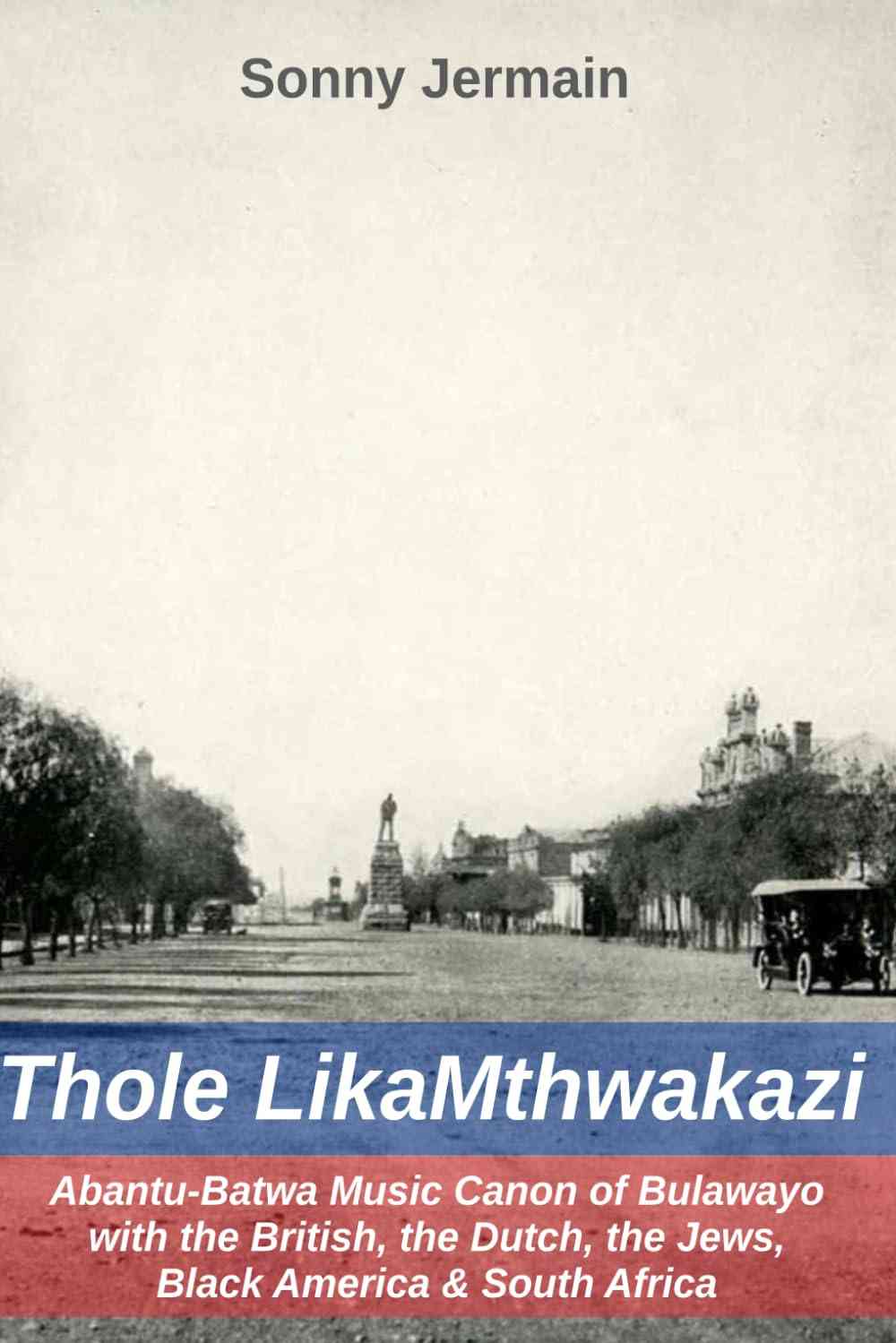
When Sonny Jermaine speaks, you don’t just listen, you recalibrate, if you’re lucky enough not to instantly reboot. He doesn’t deal in pleasantries; he dismantles amnesia with a scholar’s scalpel and an artist’s enduring fire. His latest book, Thole LikaMthwakazi, isn’t your regular nostalgia piece but a defiant excavation of long deliberately neglected memory, a love letter and simultaneously a sound punch to the gut.
We spoke over coffee, but the conversation felt more like standing at the edge of a heritage and cultural earthquake. “This isn’t just the music history of AbeThwakazi,” Jermaine begins, eyes blazing. “It’s the story of a people, the first nation, AbaThwa/Batwa. The book traces how we evolved from that fusion of Batwa and Bantu into who we are now.”
He narrates King Mzilikazi’s Mthwakazi not as a lost kingdom but as a living frequency, humming beneath every beat and every call and response rhythm that still reverberates across Africa and beyond. “We gave the world its first African superstars out of Makhokhoba,” he says proudly. “Radio Mthwakazi, Sam’wela, the whole songwriting method that became the foundation of Bantu sound, it all starts there.”
But don’t mistake Jermaine for a sensationalist and mere sentimental historian. He is a daring provocateur with receipts and well curated findings. “I’ve never been a Bible reader,” he admits, “I read the diaries of colonisers instead. They all noticed two things about us: we have a poor sense of geography and a poor sense of history. That’s tragic. Most black people only remember 50 to 100 years of history and that’s exactly why we’ve been enslaved and colonised for the past 5 000 years.” He pauses, like a silent assassin he then drops the kind of line that could echo in the corridors of academia: “Those who know, know, it’s very easy to colonise people who know little about the world they live in. Colonisation didn’t begin 500 years ago, that’s factually incorrect”, he affirms.
The book, which skilfully compresses 2,000 years of cultural evolution into a two-hour read, is as audacious as its author. Jermaine dissects the period from 1893 to 1993, the century that reshaped African identity. “That’s when we see a seismic cultural shift,” he explains. “We’ve never had the conversation about how those 100 years changed everything. You see ‘Nkosi Sikelel’ iAfrika’ being composed, ‘Shosholoza’ emerging from railway labour, Hugh Tracy warning that churches were destroying African culture as early as 1930, yet we never talked about it.”
Jermaine bravely refuses to flatten history into binaries of conformity. “Not all whites were the same,” he notes. “Without Hugh Tracy, his technician Alick Nkhata, and Eric Gallo’s record label, we wouldn’t even have an African music industry today.”
The spirited author doesn’t shy from the difficulty of documenting giants as he openly acknowledged the huddles of putting together such a well-researched body of work. “My index of names alone is twelve pages,” he laughs. “How do you squeeze AbeThwakazi into just 100 pages? But I love that I’m following in a lineage, where there was Peter Sivalo Mahlangu in 1957, Pathisa Nyathi in 1994, Cont Mhlanga in 2019, now there’s me, writing Thole LikaMthwakazi in 2025. How cool is that?”
But ‘cool’ is an understatement, the book burns with urgency. “Our kids, especially abroad, are asking hard questions,” Jermaine says. “They live in foreign lands, learn all this advanced information online and yet, when they ask their parents who they are, they get silence. That’s a tragedy.”
He leans forward, voice dropping into something almost paternal. “African parents in Europe forget what it’s like to be a kid. Their children are being asked, ‘Where are you from?’ in brutal environments. We can’t send them into that without hard facts. I wanted them to be able to say: our grandfathers Jackson Skuza, Japhet Masuku, Alick Nkhatha, played for Allied soldiers in World War II. The war would not have been won without African musicians. That’s our story too.” By the time he’s done, you realize this isn’t just a conversation; it’s a cultural intervention, a poignant act of historical continuity determined to redirect an entire generation.
The book Thole LikaMthwakazi stormed the Amazon History of Africa charts, debuting at number 1 in its first week and holding strong at number 3 throughout the entire month of December 2025.
Jermaine folded with a taunting warning disguised as prophecy: “Colonisation doesn’t just take diamonds and gold, it takes culture. What happens in villages you’ll never visit affects how you live today. And what you do here shapes their world too. The tragedy is, we don’t even know it.” He went on to chuckling darkly, tossing in a line that could be a rallying war cry or a curse if not heeded with conscious mind, “Kuzachithek’ izitshebo uma ubala!” Thus, with this offering, Sonny Jermaine isn’t asking Africa to remember, he’s daring it to wake up to her narratives and shape a desired pathway.