When the South African dream collapsed, Beitbridge — the bustling border town — quietly became a refuge for Marble Moyo*, a sex worker.
For her and a myriad of other sex workers, Beitbridge is less a choice than a last resort after failing to secure stable employment across the Limpopo River.
What was meant to be a temporary stopover has turned into a permanent, if not precarious, home for Moyo and dozens of other women trying to survive in an unforgiving economy.
Investigations by Truth Diggers reveal that a significant number of sex workers operating in Beitbridge originate from Mashonaland, Midlands and Manicaland provinces with a large chunk coming from Harare, Chitungwiza and other urban centres.
Most left Zimbabwe believing they would find work as domestic workers or in the service industry in South Africa.
Instead, economic hardship, exploitation, and unemployment forced them into a life they never envisioned.
For Moyo, the truth is too painful — and shameful — to share with her family.
Hailing from Zengeza 2 in Chitungwiza, Moyo admitted she had lied to her relatives, telling them she worked in South Africa as a maid.
- Zim headed for a political dead heat in 2023
- Record breaker Mpofu revisits difficult upbringing
- Tendo Electronics eyes Africa after TelOne deal
- Record breaker Mpofu revisits difficult upbringing
Keep Reading
“I tell my family I am still in South Africa working as a domestic worker,” she said.
“They would never understand what I am really doing.”
Another woman, who preferred to be called Lolo and is from Marondera, narrated her descent into sex work — a journey that began far from the streets of Beitbridge.
“If I can tell you, I was an avid churchgoer until I moved to South Africa to work as a maid,” she said.
Her hopes crumbled when her employer relocated to the United Kingdom.
“My boss left for the UK. I couldn’t secure another job in South Africa. A friend then introduced me to sex work,” she explained.
But even in South Africa, she found the profession too dangerous.
“I could not continue doing sex work there because it was risky. That is when I moved to Beitbridge,” Lolo said.
“I have kept it a secret from my family that I am doing sex work here, considering I was a God-fearing woman.”
The emotional weight of her situation is heavy.
“I can’t go back home and face my family because there is a burden on my shoulders,” she said.
“Everyone is looking up to me. The little that I get here, I send it home.”
Poverty in Zimbabwe remains widespread, but the burden falls disproportionately on women, particularly in rural areas.
Women face higher unemployment, are overrepresented in informal and insecure work, have less access to income-generating assets, and experience greater food insecurity.
According to the United Nations in Zimbabwe, female-headed households in the country face higher multidimensional deprivation (19%) compared to male-headed households (13.3%), meaning women experience deeper poverty across several dimensions (education, health and living standards).
Moyo and Lolo’s stories mirror that of many others — women caught between stigma, survival, and responsibility.
Economic desperation has pushed many to “sell their bodies for a song,” as one Beitbridge resident put it.
With limited opportunities in formal employment, sex work has become one of the few viable means of income.
Truth Diggers established that many sex workers reside in makeshift brothels — ordinary houses converted into shared accommodation, mainly in Dulibadzimu, Beitbridge’s oldest suburb.
They reportedly pay daily rentals of around 50 rand per person.
Here living conditions are far from ideal. Four to six women share a single room, divided by hanging curtains that offer little privacy.
By day, this part of Beitbridge appears quiet. By dusk, a different world emerges.
As darkness falls, the women converge at a well-known spot called KuMadurawall, a popular “touchline” where sex workers solicit for clients.
Their customers range from truck drivers and border jumpers to travellers — and even, reportedly, police officers.
“You never know who will stop for you,” a sex worker called Tsitsi said.
“Some are kind, some are dangerous. Some don’t want to pay.”
Several sex workers reported incidents of verbal abuse, non-payment, and physical threats.
Yet few feel safe to report such cases to the police — partly because some officers are alleged to be clients themselves.
Truth Diggers went undercover and discreetly engaged Tsitsi.
After a brief, cautious exchange in hushed tones, she gestured for the me to follow her through a narrow, unlit pathway into one of the converted houses in Dulibadzimu.
Inside, the air was heavy and the space crowded; muffled conversations from other rooms bled through the thin walls.
She led me down a short corridor and parted a hanging curtain that served as a “door” to her sleeping space — a small area dominated by a thin mattress on the floor and a single plastic chair.
There was no lock, no solid barrier, and no real privacy, only fabric separating us from the activity next door.
Before entering, she quickly negotiated the terms: 30 rand for a short encounter, making it clear she was not prepared to stay for the full night.
The entire interaction — from approach to agreement — was brisk and transactional, underscoring how hurried, precarious and exposed these arrangements are in practice.
After taking mental notes of the conditions and confirming the price, this reporter paid the 30 rand, exited the room, leaving the curtain to fall back into place behind me.
“On a good day, I serve 15 clients a day,” Lolo said.
“However, on a bad day it can be difficult to even raise the 50 rand daily rental.
“That’s when we negotiate with the landlord for a payment plan.”
Truth Diggers established that several landlords are former sex workers, who are past their prime time.
“I built this house during my time as a cross border trader of which I would also do sex work to supplement my income,” said Mai Chari, who operates a brothel in Dulibadzimu.
“My tenants are mostly sex workers and I charge daily rentals.”
Mai Chari said about 14 sex workers were sharing three of her rooms.
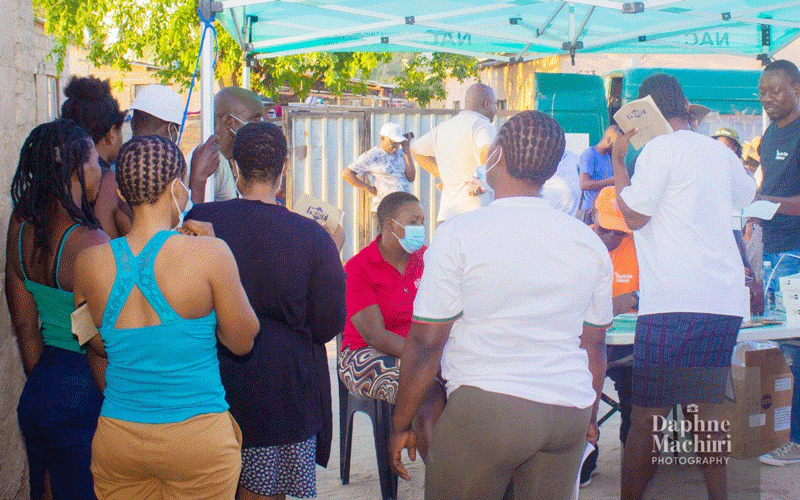
Long exposed to heightened HIV risk due to mobility, stigma and limited access to conventional health services, sex workers in this part of Beitbridge are now benefiting from an integrated care model that combines clinic-based services with flexible outreach — including night-time moonlight services.
The Beitbridge Wellness Centre is emerging as a critical lifeline for vulnerable populations, delivering healthcare that matches the realities of life at the country’s busiest border post.
The programme is led by the National Aids Council (NAC) in partnership with North Star Alliance and the Ministry of Health and Child Care.
It provides a safe, non-judgemental space offering HIV testing, STI treatment, contraception, psychosocial support and HIV prevention services under one roof.
Its approach prioritises dignity and confidentiality, helping clients access care without fear of discrimination.
“Our aim is to make healthcare accessible and respectful, especially for those who are often excluded from traditional systems,” said North Star Alliance site co-ordination nurse Nyarai Shumba
Recognising that sex work in Beitbridge largely takes place after dark, the centre extends its reach through moonlight services — a mobile night outreach programme that brings healthcare directly to sex workers during their working hours.
This model has helped close critical gaps in access created by daytime clinic limitations.
“At night, it’s easier for us to get help,” Moyo said.
“We can talk freely and get services when we need them.”
While daily oral pre-exposure prophylaxis (PrEP) has played a key role in HIV prevention, adherence has remained a challenge in a highly mobile border town.
Frequent travel, irregular routines and fear of being seen with medication often interrupt consistent use.
Beitbridge district Aids coordinator Edward Mlaudzi said the district has about 2 000 sex workers, including some aged between 15 and 19 years.
The district’s HIV prevalence is 14,5% and has a 0,2% incidence rate.
“HIV positivity among sex workers is three times higher than in the general population,” Mlaudzi said.
He said NAC was working with the Ministry of Youth Empowerment, Development and Vocational Training, and the Ministry of Women Affairs, Community, Small and Medium Enterprise Development to empower young sex workers through short courses or returning them to school.
For sex workers in Beitbridge, the combination of flexible service delivery and innovative prevention tools is transforming access — and offering renewed hope for a healthier future.
Development practitioner Takemore Mazuruse said Beitbridge’s hidden sex economy was not just a local issue — it reflected broader national crisis of unemployment, gender inequality and the absence of social safety nets.
“These women are not just sex workers — they are migrants, mothers, daughters and breadwinners operating in a system that has failed them,” Mazaruse said.
“Beitbridge may have become their sanctuary, but it is a sanctuary without security, a refuge without rights.” (*Not real name)
*Truth Diggers is the investigative unit of Alpha Media Holdings (AMH), publishers of NewsDay, Zim Independent, The Standard and Southern Eye. AMH also operates an online broadcasting channel HStv