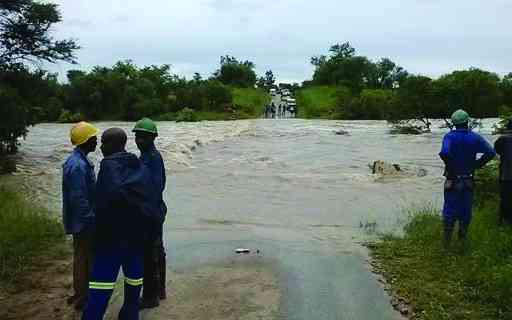
The state of highways and rural roads in Matabeleland has deteriorated, with some areas becoming inaccessible after bridges were destroyed by heavy rains and roads were cut off.
This has raised concerns that the region’s infrastructure, especially roads, has been neglected for too long.
Mthwakazi Republic Party president MqondisiMoyo said the condition of Matabeleland’s roads signified a deliberate attempt by the Zanu PF government to marginalise the region.
Moyo said as the marginalisation of Matabeleland continued, access roads to the region were left to collapse, even as significant funds from the fiscus were spent in other parts of the country.
He noted that just this past week, as rains pounded Matabeleland, Old Bulawayo-Gwanda road in Gulabahwa—a sacred ancestral shrine of the Ndebele and Kalanga people in Umzingwane district—totally collapsed.
He attributed the state of the road to state neglect, institutional incompetence, and deliberate marginalisation by the government.
“It is the direct and foreseeable consequence of state neglect, institutional incompetence, and deliberate marginalisation by the government of Zimbabwe and its Ministry of Transport and Infrastructural Development,” Moyo said.
On Friday, a crossing bridge on the Old Bulawayo-Gwanda road gave way following persistent heavy rains, cutting off entire communities, paralysing movement, severing access to markets, schools, clinics, and places of worship, and placing lives in immediate danger.
- I will definitely win 2023 elections: Mwonzora
- We will rule forever: ED says
- Candid Comment: Monetary authorities living in a fool's paradise
- Measles death toll hits 650
Keep Reading
“This road is not a luxury; it is a lifeline. Its collapse once again exposes how Matabeleland is treated as a disposable hinterland by a Harare-based government that neither listens nor cares,” Moyo said.
“Gulabahwa is not merely a geographic location; it is a sacred ancestral site of immense spiritual, cultural, and historical significance,” he noted.
“Yet even roads passing through areas of such importance are left to decay into death traps.”
Moyo said rivulets were crossed by crude, temporary structures, bridges are never reinforced, drainage systems are ignored, and routine maintenance is virtually non-existent. He described this as “criminal negligence masquerading as governance.”
The Gulabahwa collapse is part of a series of infrastructure failures witnessed across Matobo and Gwanda districts within the same week.
“At Nathisa, towards Kezi in Matobo district, a vehicle was swept away while attempting to cross a low-level bridge over the Hovi/Ovi River, swollen by incessant rains,” Moyo said.
“That motorists are still forced to risk their lives at low-level crossings in 2026 is a damning indictment of a state that has abandoned even the most basic public-safety standards.”
The MRP leader said Gwanda town has effectively been split in two, with residents living across the Mtshabezi River toward Vumbachikwe and Blanket Mine completely cut off from the city.
“The low-level bridge over Mtshabezi has remained submerged for days, making it impossible to access schools, hospitals, workplaces, shopping facilities, and emergency services.
“Children are missing school,” he said.
“Patients cannot reach clinics. Economic life has ground to a halt — not because the rains were unexpected, but because the state never built proper all-weather infrastructure.”
He described these as not isolated incidents, but structural failures, emphasising that the region is deliberately left behind.
“Across Matabeleland, the same story repeats itself: the Beitbridge–Bulawayo Road, a regional trade corridor, turned into a graveyard; the Bulawayo–Victoria Falls Road, neglected despite its tourism and economic value; the Bulawayo–Tsholotsho Road, a permanent symbol of abandonment; the Bulawayo–Nkayi Road, trapping rural communities in poverty; and the Gwanda–Maphisa Road, left to deteriorate despite its economic importance,” Moyo said.
“Numerous inter-district and district-centre roads have been written off entirely.
“These roads were better maintained during Ian Smith’s era than under today’s post-independence government—a fact that should shame every official responsible for infrastructure planning and delivery.”
He said this is especially tragic because the central government collects substantial revenue through vehicle licenses and tollgates, raising the urgent and unavoidable question of where the money meant for roads is going.
“Zimbabweans, including the people of Matabeleland, are relentlessly taxed and levied in the name of road construction, maintenance, and improvement through multiple revenue streams,” Moyo said.
These include vehicle licensing fees (ranging from approximately US$20 to over US$300 depending on vehicle category), fuel levies (currently US$0.2470 per litre for petrol and US$0.1870 per litre for diesel under Statutory Instrument 50 of 2025), transit fees for regional and international vehicles, and Road Access Fees administered by the Zimbabwe National Road Authority.
“These charges generate hundreds of millions of US dollars annually,” Moyo said.
“Yet in Matabeleland, roads collapse, bridges wash away, and communities are cut off for days or weeks at a time.
“So the question must be asked—loudly and without fear—where is this money being invested, if not in Matabeleland?”
The government has claimed it is rehabilitating the Bulawayo–Victoria Falls and Bulawayo–Nkayi roads, but motorists on the ground report shocking scenes of deterioration, making passage difficult, especially after recent rains.
Last year, Transport and Infrastructural Development minister Felix Mhona was awarded for being a hard-working minister, despite the poor state of the roads.