THE government still owes some traditional leaders outstanding allowances for the Gukurahundi community outreach programme, despite recent disbursements.
President Emmerson Mnangagwa tasked chiefs to lead the outreach programme aimed at finding closure to the Matabeleland massacres.
The outreach programme has faced persistent funding constraints since its inception.
Government allocations have been inconsistent, with treasury often releasing funds in delayed, irregular batches.
Traditional leaders have occasionally been forced to cancel community meetings or use their own resources to reach remote villages.
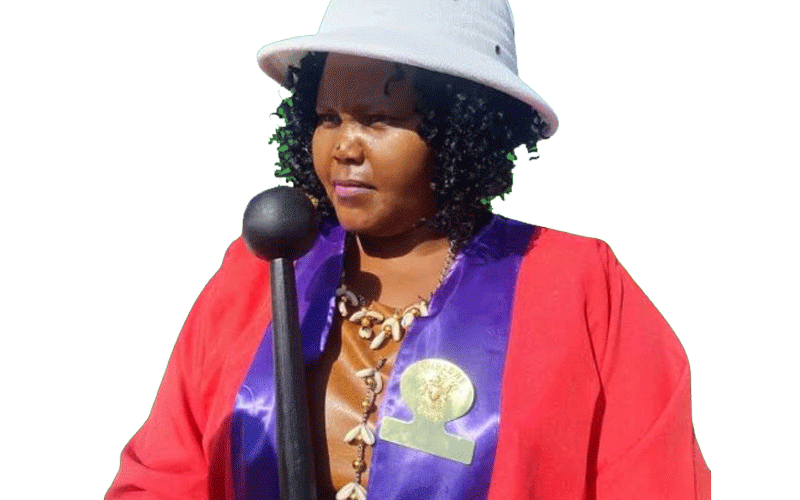
According to Chiefs Council president Mtshane Khumalo, some funds were recently released to clear part of the arrears from previous months.
Khumalo acknowledged that isolated payment issues persist, particularly relating to personnel replacements and vehicle hire logistics.
“We received part of our money for the outreach. Our monies were paid this year and the arrears were paid some one or two months ago,” Khumalo said in an interview.
- Ziyambi’s Gukurahundi remarks revealing
- Giles Mutsekwa was a tough campaigner
- New law answers exhumations and reburials question in Zim
- Abducted tourists remembered
Keep Reading
Khumalo attributed the delay to communication breakdowns.
“I wrote a letter when they were bringing the last batch of the money,” he added.
“They said they didn’t receive the letter. I had to then write another one.
“So, I have been following the second letter, checking how far they have gone. I then found the person not around, but otherwise no credit remained.”
Sources familiar with the process indicated that budget shortfalls have forced the programme to operate on a month-to-month basis, making forward planning difficult.
The sources said the bottlenecks have severely hampered operations.
Khumalo highlighted vehicle hire as a major stumbling block.
“It’s just that those dealing with hiring of vehicles don’t deal with us mostly, they deal with CMED. I had heard they were saying it was owed for two months, but I’m not sure of what happened,” he said.
CMED (Central Mechanical Equipment Department), which provides government transport, has reportedly demanded upfront payment or accumulated overdue bills, leading to vehicle shortages for outreach teams.
Other bottlenecks include frequent personnel changes within outreach teams without proper handover documentation, slow government payment approval processes requiring multiple layers of authorization and poor communication between the Chiefs Council, local government ministry, and treasury.
The outreach programme is part of government efforts to address the legacy of Gukurahundi -the 1980s disturbances that killed thousands in Matabeleland and Midlands provinces.
Under the initiative, traditional leaders facilitate community truth-telling and reconciliation meetings.
But funding instability and logistical hurdles continue to undermine its credibility and effectiveness, critics say.
Mnangagwa, who was the State Security minister during the Gukurahundi massacres in Matabeleland and Midlands soon after independence in 1980, promised to ensure a quick resolution to the issue but nothing tangible has been delivered nine years after he seized power from the late Robert Mugabe.