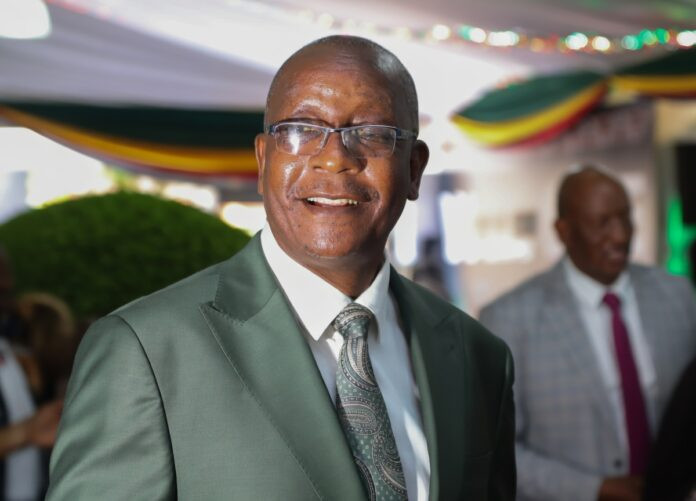
JUSTICE, Legal and Parliamentary Affairs minister Ziyambi Ziyambi has ignited fierce criticism after rejecting descriptions of the 1983-87 Gukurahundi atrocities as genocide, insisting they were the result of conflict rather than a deliberate State policy to eliminate a particular ethnic group.
The remarks, made during a Senate debate on the Constitution of Zimbabwe Amendment No. 3 Bill, renewed long-standing tensions over how one of Zimbabwe’s darkest chapters should be officially recognised and addressed. Victims’ groups accuse the government of denying historical atrocities and undermining efforts toward justice and national healing.
Ziyambi made the comments last week after Senator Sengezo Tshabangu called on Parliament to enact legislation within 12 months to ensure national healing efforts continue beyond the lifespan of the National Peace and Reconciliation Commission.
Backing the constitutional amendment, Tshabangu urged lawmakers to address atrocities committed between 1983 and 1987.
“There was genocide in 1983 to 1987. We are still lagging and we want to be like Rwanda. As long as this is not done, we are foreigners in our own land,” Tshabangu told the Senate.
Ziyambi disputed the description.
“I do not believe there was genocide in Zimbabwe. In fact, there was no genocide,” he said.
“There was a conflict, but there was never a deliberate government policy at any one time to eliminate one tribe against the other.”
- Ziyambi’s Gukurahundi remarks revealing
- Giles Mutsekwa was a tough campaigner
- New law answers exhumations and reburials question in Zim
- Abducted tourists remembered
Keep Reading
The remarks drew swift condemnation from pressure groups and activists in Matabeleland, who accused the minister of distorting history and re-traumatising survivors.
In a statement, Ibhetshu LikaZulu secretary-general Mbuso Fuzwayo said the organisation rejected “with grave concern and outright condemnation” the minister’s characterisation of Gukurahundi.
“The operation was not a spontaneous clash between communities,” Fuzwayo said.
“Statements made by various ministers and senior government officials at the time made clear that the intention was to completely wipe out a group of tribes and ethnic groups clustered under the Ndebele identity.”
Ibhetshu LikaZulu cited the 1948 United Nations Convention on the Prevention and Punishment of the Crime of Genocide, arguing that the atrocities met the legal definition of genocide because they were allegedly committed with the intent to destroy, in whole or in part, an ethnic group.
The organisation also referred to findings by historians and human rights organisations, including the Catholic Commission for Justice and Peace’s 1997 report, Breaking the Silence, Building True Peace, which documented widespread abuses allegedly committed by the 5 Brigade military unit in Matabeleland and parts of the Midlands.
“There was no justification for the government to embark on this campaign,” Fuzwayo said.
“Even the explanation advanced at the time regarding dissidents does not and cannot justify the mass killing, torture, disappearance and displacement of civilians.”
The group called for official recognition of Gukurahundi as genocide, prosecution of those responsible, reparations for victims, survivor-led memorialisation initiatives and legislation criminalising what it termed “Gukurahundi denialism”.
“Public officials must refrain from statements that distort history and re-traumatise survivors,” he said.
Fuzwayo said the organisation remained committed to “truth, justice and healing” for victims and survivors.
“We will not allow the genocide to be reduced to a ‘conflict’ for political convenience,” he said.
The South Africa Charter Youth Wing of the Mthwakazi Republic Party also condemned Ziyambi’s remarks, accusing him of attempting to erase history.
In a statement, the group said civilians in Matabeleland and parts of the Midlands were systematically targeted by the 5 Brigade between 1983 and 1987.
It cited survivor testimonies from Tsholotsho and Silobela, including allegations of torture, enforced disappearances and killings at the Bhalagwe detention camp.
“Zanu PF has never agreed that Gukurahundi was genocide. But the mass graves, the Bhalagwe shafts, the closed schools, the burned huts, and the silenced villages prove otherwise,” the statement read.
Human rights organisations estimate that more than 20 000 civilians were killed during the military crackdown in Matabeleland and the Midlands, although the exact death toll remains disputed.
Authorities said the military intervention was meant to quell disturbances, although critics claimed it was part of Zanu PF’s grand plan to establish a one-party State.
Successive Zimbabwean governments have acknowledged that widespread atrocities occurred during Gukurahundi but have generally resisted classifying the violence as genocide.
The late former President Robert Mugabe once described the killings as “a moment of madness,” while President Emmerson Mnangagwa has launched community hearings and engagement processes aimed at addressing unresolved grievances linked to Gukurahundi.
Critics, however, argue that the process has lacked transparency, independence and accountability.