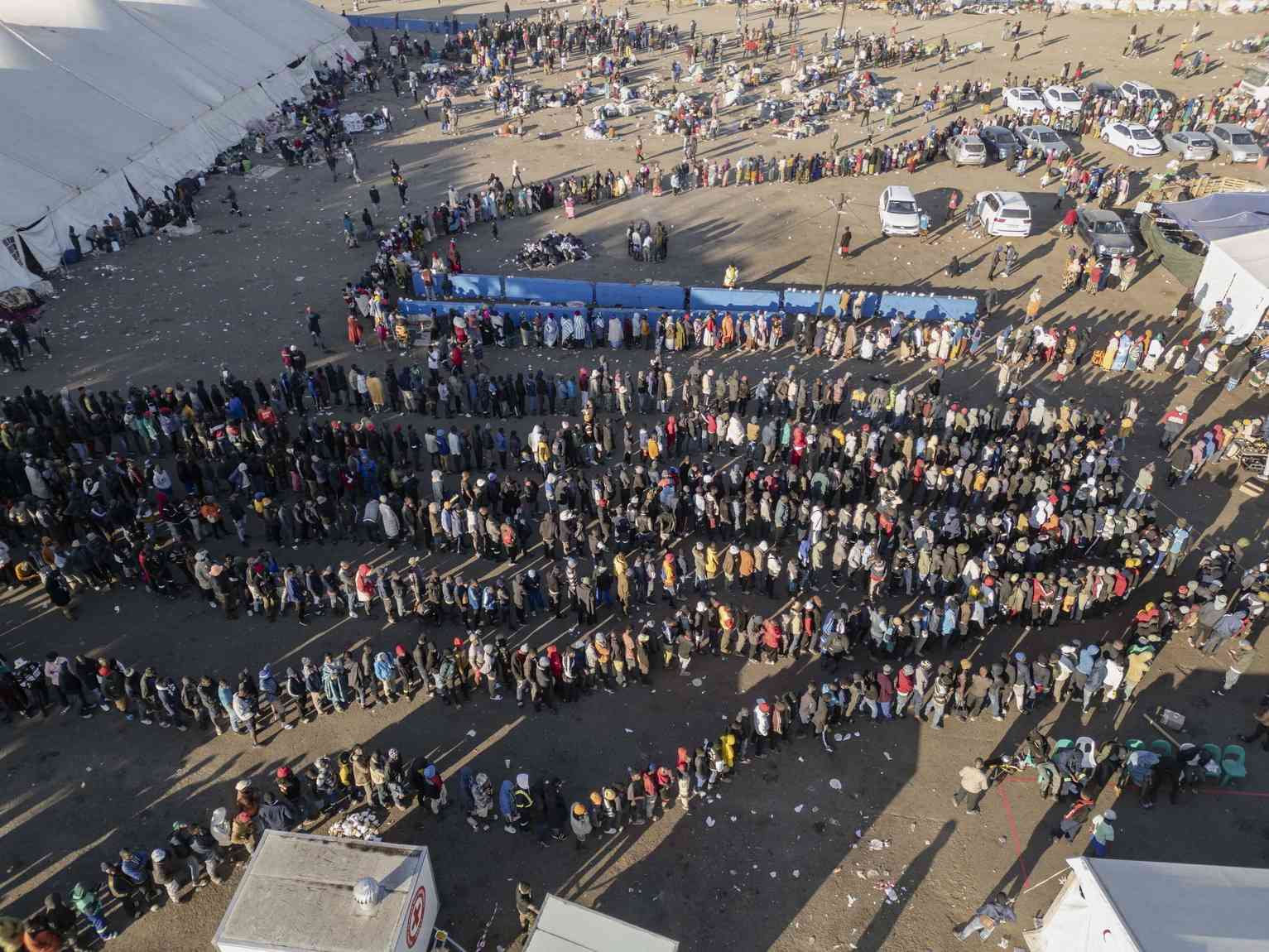
The line of people that seems to exist outside of time at Beitbridge border post is testimony to the fact that no one packed for this journey.
Men carry plastic bags knotted at the top. Women balance bundles of clothing on their heads.
Children sleep on shoulders, half-aware of the movement around them. Suitcases drag over concrete that has been worn down by decades of crossings.
Some people sit in silence, waiting for documents to be checked again. Others stand, unsure whether waiting or walking is safer.
A border official later describes the movement as “several thousands” in a short period. But numbers do not capture the atmosphere. Fatigue does. So does silence.
And so does the way people avoid looking too far ahead.
For many, this is not a first crossing. It is a return crossing. Southward once carried hope. Northward now carries uncertainty.
To understand the present, one must first understand the habit of movement.
- Zim headed for a political dead heat in 2023
- Record breaker Mpofu revisits difficult upbringing
- Tendo Electronics eyes Africa after TelOne deal
- Record breaker Mpofu revisits difficult upbringing
Keep Reading
For more than a century, Southern Africa has been shaped by labour migration. Men from Zimbabwe, Malawi, Mozambique, Lesotho and elsewhere travelled south to work in South Africa’s mines, farms, railways and later its expanding urban economy.
The system was once formalised through recruitment agencies and contracts. Entire villages depended on remittances sent from the gold fields of the Witwatersrand.
After 1994, the pattern did not disappear. It changed.
South Africa’s economy became more diversified — construction, retail, hospitality, services. The demand for labour did not decline. It shifted.
And as regional economies struggled with slow growth, migration became not an exception, but a continuation of a long-standing regional rhythm.
For many families, it was not migration. It was survival strategy.
In Pretoria, that history is still visible — but increasingly tense. Some streets appear normal at first glance: taxis moving, vendors selling, office workers walking between buildings.
But the texture has changed.
Shop owners in parts of the central business district have closed earlier than usual. Some did not open at all during recent periods of heightened tension. Security presence has increased in key areas. Conversations in public spaces are shorter, more cautious.
Languages shift constantly across the city — Xhosa, Zulu, Shona, English — but tone has become more restrained.
Taxi drivers speak less about routes and more about uncertainty.
“There is no movement. It has changed,” one says simply.
What is not visible is equally important: people staying indoors, avoiding streets, adjusting routines in ways that do not appear in official statistics.
Philemon Mukorera is 26. He arrived in South Africa four years ago with a degree in Banking and Finance from Midlands State University in Zimbabwe. It is a qualification that, on paper, suggested a different trajectory.
But reality redirected him. He now works as a workshop assistant in Pretoria. When asked about his education, he pauses longer than expected.
“I feel like the four years I wasted at university were my worst,” he says.
“Now I don’t even want to hear anyone tell me about Banking and Finance.”
The words are not angry. They are detached—like something repeatedly rehearsed until emotion has been removed.
He was married in December in Norton, Zimbabwe. The marriage was formalised with family introductions, the kind of ceremony that signals permanence rather than experiment. But permanence, in his case, now feels conditional.
“I will make do with what I’m doing now. At least it puts food on the table for me and my new wife,” he adds.
What began as economic migration has become something more fragile: a life built on uncertain legality, fragile routine, and the constant possibility of disruption.
Not far from this world is another.
Thembalami Molebaleng is 40, a salesman for a tyre manufacturing company. He is employed, stable, and by his own account, unaffected personally by migrant labour.
His argument is not rooted in immediate hardship. It is rooted in governance.
He believes immigration enforcement has been weak and inconsistent. He argues that the state bears responsibility for what he sees as uncontrolled movement of people.
“The government should support the demonstrations financially,” he says. It is the one that created the mess in the first place,” he argues.
Molebaleng distinguishes clearly between documented and undocumented migrants.
His concern, he insists, is not with nationality but with enforcement. In his view, the issue is structural failure rather than individual presence.
That distinction matters. It complicates assumptions about who supports anti-immigration sentiment and why.
During recent periods of unrest, Pretoria has not become a city of chaos—but of caution. Shop shutters close earlier. Security patrols increase. Movement slows in certain districts.
Taxi drivers report reduced business. Traders adjust opening hours. Some residents avoid public spaces altogether.
“There are fewer people outside,” one driver says.
“It is not normal.”
There is no single visible trigger. Instead, there is accumulation: fear, rumours, uncertainty, enforcement, protest. What emerges is not disorder, but withdrawal.
Over a drink in Pretoria Chris Muleya, who is from Beitbridge, speaks about patterns he believes are repeating themselves.
He recalls earlier episodes of violence in the country such as Dudula, suggesting that current tensions resemble past cycles of unrest.
He also raises the possibility of political influence behind mobilisation efforts, pointing to what he perceives as organisation and resources that suggest coordination beyond spontaneous protest.
At the same time, he acknowledges economic pressure as a root factor. South Africa’s unemployment rate, he says, cannot be ignored. But his conclusion is cautionary.
“I believe it’s best for our brothers and sisters to return home,” he says. It is a war they will never win,” he says.
The word “war” lingers—not as literal description, but as emotional framing of a struggle he believes is unsustainable.
At Beitbridge, movement becomes infrastructure. The Border Management Authority confirms processing “several thousands” of Zimbabweans and Malawians in coordination with Home Affairs, embassies, and security forces.
Commissioner Michael Masiapato notes intensified enforcement measures, including surveillance technologies such as drones. It is evident the language of borders is now also the language of systems:
Monitoring, processing, verification and interception. But on the ground, systems meet exhaustion.
Some travellers arrive with documentation. Others do not. Some are processed quickly. Others wait in Musina, uncertain when or whether they will continue. Fatigue is visible in posture, in silence and in the way people sit without speaking for long periods.
Many have not slept properly in days. Their belongings are minimal, yet their uncertainty is not.
Migration in Southern Africa is not new. What is new is its emotional temperature. Where once movement was expected, it is now contested. Where once labour was structured, it is now precarious. Where once borders facilitated exchange, they now increasingly define exclusion.
South Africa remains the region’s most industrialised economy. It continues to draw labour across its borders.
But it also faces internal pressures: unemployment, inequality, political strain.
These realities exist simultaneously. They do not cancel each other out. They coexist in tension.
At Beitbridge, one man crosses northward carrying a suitcase that once carried hope southward. He does not speak much. Neither do those around him.
The river beside the crossing – Limpopo - does not change course. It moves as it always has. Indifferent to direction. Indifferent to outcome.
Between South Africa and Zimbabwe, between departure and return, between expectation and reality, the same question persists: What does it cost to belong?
Belonging is not a legal status. It is not a border stamp. It is not a protest slogan.
It is something slower, more fragile, negotiated daily in work, language, fear, trust, and acceptance.
For some, South Africa remains opportunity.
For others, it has become uncertainty. For those returning north, Zimbabwe is not simply home.
It is re-entry into an economy that had already been left behind.
And for the region as a whole, the movement raises a quieter question—less visible than protests, less measurable than statistics: Whether Southern Africa’s shared history of movement can survive a present increasingly defined by hesitation.
Tomorrow, the queues will form again. More documents will be checked. More suitcases will roll across concrete. More decisions will be made under uncertainty.
And long after the news cycle moves on, the region will remain with a question it has not yet resolved:
Not who belongs.
But what belonging has become.