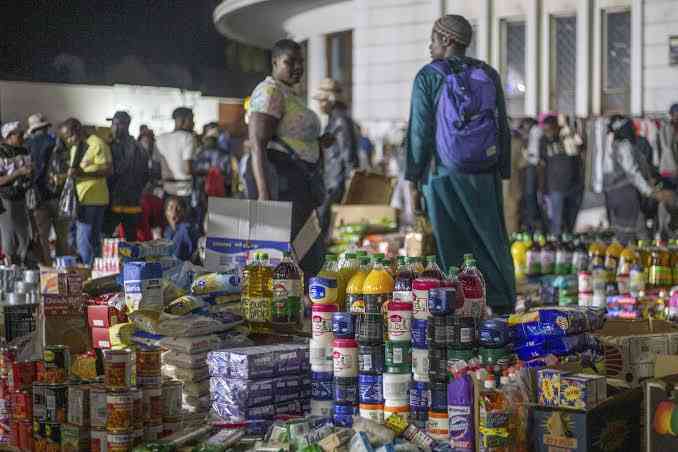
Across Zimbabwe’s cities and towns, thousands of people continue to operate unlicensed tuckshops, backyard workshops, street vending stalls, informal transport businesses and home industries despite repeated crackdowns by local authorities and the Zimbabwe Republic Police.
Municipal raids have become a common sight in urban centres such as Harare, Bulawayo, Gweru and Mutare, where vendors and small-scale traders are often arrested, fined or have their goods confiscated for operating without valid licenses.
Yet, despite the risks, the number of informal and illegal businesses continues to grow.
Economic analysts, vendors and small business operators say this rise is not necessarily driven by criminal intent, but by a combination of poverty, unemployment, expensive licensing requirements, bureaucracy and the collapse of the formal economy.
Zimbabwe’s licensing system requires businesses to comply with several procedures before they can legally operate.
To obtain a shop license, operators must produce tax clearance certificates from the Zimbabwe Revenue Authority (Zimra), approved trading permits, enabling certificates and pay fees ranging between hundreds of United States dollars, depending on the nature of the business.
For many struggling Zimbabweans trying to survive in an economy marked by company closures and high unemployment, these costs are simply out of reach.
“We are not refusing to obey the law, but the process is too expensive for ordinary people.
- War over super car stuck in river
- Zimra seizes CCC campaign vehicle
- Crime tech: Technology can eradicate corruption
- Firearms smuggling suspect weeps in court
Keep Reading
“Before you even make profits, you are already required to pay hundreds of dollars in licenses, permits and inspections,” said a small tuckshop operator in Bulawayo.
According to Bulawayo City Council licensing services regulations, new business applicants must have their premises inspected by health inspectors before obtaining a temporary trading permit.
They must also secure tax clearance certificates and eventually apply for full shop licenses, with fees ranging from US$345 to US$700 depending on operations.
Liquor traders face even steeper requirements, including nearly US$700 for liquor licenses, while vehicle operators, bicycle owners and pushcart operators are also subject to various charges.
Critics argue that the licensing structure was designed for a functioning formal economy and does not reflect the realities facing ordinary Zimbabweans today.
With years of economic instability, currency fluctuations, inflation and widespread company closures, the informal sector now employs the majority of Zimbabweans.
The late Zimbabwean economic commentator John Robertson once observed that when formal industries collapse, survival entrepreneurship inevitably rises.
Many illegal businesses are therefore born out of desperation rather than deliberate lawlessness.
In high-density suburbs, residents have converted homes into salons, welding shops, grocery stores and restaurants without municipal approval.
Some operate from containers or roadside stalls because renting formal commercial premises is unaffordable.
“You need rent, licenses, taxes, transport money and inspection fees. Most of us are selling tomatoes, clothes or snacks just to feed our families. We do not have that kind of capital,” said a vendor in Bulawayo.
Besides high costs, bureaucracy discourages compliance, long queues, multiple offices, complicated paperwork and permit delays frustrate entrepreneurs.
To transfer motor vehicle ownership, for example, residents must produce registration books, insurance cover notes, proof of residence, police clearances and tax certificates, and pay processing fees.
Similar hurdles exist for many other licences.
Corruption also fuels illegal operations, with some traders alleging that bribes are demanded during inspections or enforcement operations, encouraging them to remain underground rather than formalise.
Urban governance experts argue that heavy-handed crackdowns without addressing root causes will not solve the problem.
“Local authorities must understand that informal traders are a product of economic failure. You cannot police away poverty.
“Authorities need to simplify licensing systems, reduce costs and create affordable pathways into the formal economy,” said a Bulawayo-based urban planning researcher.
Others suggest special low-cost permits for micro-enterprises instead of commercial-scale fees.
Despite periodic raids and confiscations, illegal businesses remain deeply woven into Zimbabwe’s urban economy, providing affordable goods and services to millions while sustaining entire households.
Analysts warn that unless the broader economy improves, the informal sector will continue growing regardless of enforcement.
For many locals, operating an unlicensed business is not a choice between legality and illegality, but a choice between survival and hunger.
These concerns come as Bulawayo City Council has approved plans to relocate informal traders operating at the junction of 12th Avenue and Lobengula Street, commonly known as the “Zesasite,” to Lobengula Street Mall (Site 6) in the central business district.
The relocation targets micro, small and medium enterprises (MSMEs) selling fruits, vegetables, new clothing and second-hand apparel.
Council said the traders were originally displaced following the temporary closure of the Egodini Terminus redevelopment project, which had resulted in informal activities being moved to various sites, including one along 12th Avenue near Fortwell.