Emerging geopolitical tensions across the global economy have become deeply worrying, not merely because of rising rivalries among major powers, but because of what these tensions reveal about the fragility and inequity of the international economic order.
For the first time in decades, advanced economies are openly abandoning the orthodoxies that once defined global capitalism.
Governments that previously championed free markets, minimal state intervention, and globalisation are now aggressively intervening in their domestic economies — subsidising strategic industries, restricting exports of critical commodities, and discriminating against investors and firms from so-called “enemy nations”.
This shift is not, in itself, surprising. What is troubling, however, is the asymmetry it exposes. When advanced economies deploy state power to protect or restructure their economies, they do so with relative impunity.
When developing economies attempt similar interventions, they are often punished — through sanctions, capital flight, credit downgrades, trade retaliation, or subtle diplomatic pressure.
The result is a deeply uneven global system in which the policy space available to countries depends less on economic logic than on geopolitical power.
As the global economy becomes more fragmented and vulnerable, it requires little imagination to see who stands to lose the most if a serious regression occurs.
Developing economies — Zimbabwe included — are far more exposed to external shocks, trade disruptions, and financial instability than their advanced counterparts. Unlike rich countries, they cannot freely subsidise industries, impose capital controls, or restructure markets without attracting punitive responses.
- Zim must step up to increase exports: UK
- Global trade: Unfolding curse of low expectations
- ‘Graft blighting Zim trade’
- Zim lithium production to drop: Think-tank
Keep Reading
Their policy choices remain subject to the explicit or tacit approval of more powerful states. This imbalance sits at the heart of today’s global economic crisis.
Compounding these challenges is the slow but unmistakable disintegration of the global economic architecture that governed international trade for decades.
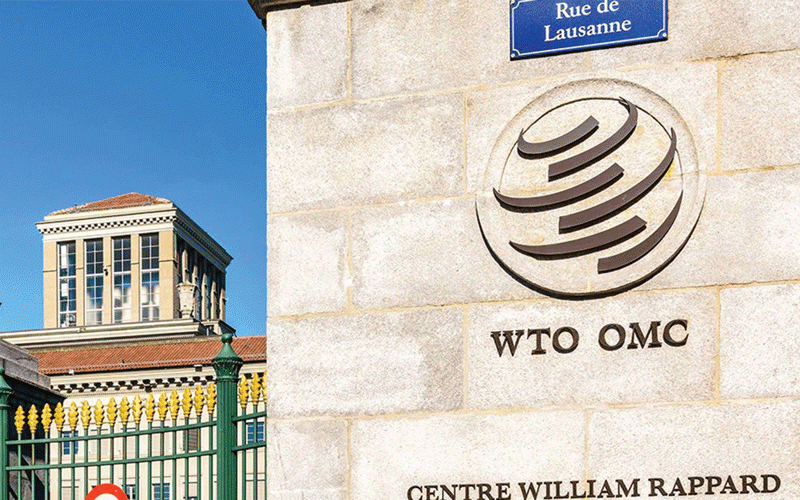
That system, anchored by institutions such as the World Trade Organisation (WTO), was designed to provide predictability, fairness, and rules-based dispute resolution. Today, those foundations are cracking.
One of the clearest illustrations of this breakdown came in April 2025, when the United States announced a new regime of so-called “reciprocal tariffs”.
These unilateral tariffs violated the core principles of the WTO, of which the US remains a founding and influential member. Most notably, they breached the principle of Most Favoured Nation (MFN) treatment, which requires that countries without preferential trade agreements be subjected to uniform tariff levels.
Instead, the US imposed differentiated tariffs on countries with which it has no trade agreements, effectively reintroducing discrimination into the global trading system. Even more striking was the fact that these tariffs undermined existing preferential agreements.
Countries such as Canada and Mexico — previously entitled to duty-free access under longstanding arrangements — found themselves facing minimum tariffs of 10% on exports to the US.
The unilateral abrogation of trade commitments before their agreed expiration dates represented a profound challenge to the credibility of the global trade system.
If the world’s largest economy can openly disregard WTO rules and its own trade agreements, the question inevitably arises: what remains of the rules-based order?
The problem is not limited to tariffs. The organisation’s Appellate Body, responsible for issuing final rulings on trade disputes, has been unable to function because the United States has repeatedly blocked the appointment of new judges.
As a result, trade disputes can now be appealed “into the void”, leaving no enforceable resolution.
This institutional paralysis has cast serious doubt on the adequacy of the existing global economic order. It has also underscored a deeper truth: international economic institutions are not neutral arbiters.
They are shaped by the power relations that created them, and they tend to reflect the interests of advanced economies far more than those of developing ones.
Bias in global economic rules
Critics have long argued that key components of the global economic framework — including Preferential Trade Agreements, Bilateral Investment Treaties, and the Investor-State Dispute Settlement (ISDS) mechanism — are structurally biased in favour of wealthy countries and multinational corporations.
Many of these agreements contain provisions that severely limit the ability of governments in developing countries to shape investment in ways that support domestic industrialisation.
For instance, governments are typically prohibited from requiring foreign investors to transfer technology or intellectual property to local firms as a condition of market entry.
A multinational automobile manufacturer establishing operations in Zimbabwe, for example, cannot legally be compelled to share technical knowledge with local producers who may wish to enter the same industry.
This was not always the case. Prior to the establishment of the WTO in 1995, governments had far greater freedom to negotiate technology transfer arrangements.
Patents were protected for shorter periods, and states could use regulation to ensure that foreign investment contributed meaningfully to domestic capability building.
Today, by contrast, patented technologies enjoy protection for a minimum of 20 years, and technology transfer has become largely non-negotiable.
The result has been a slower diffusion of innovation from advanced economies to the rest of the world. Strong protections for intellectual property — through patents, trade secrets, and related mechanisms — have entrenched technological monopolies and widened the development gap.
From a global welfare perspective, the world would arguably be better off with more flexible rules that prioritise widespread access to innovation over excessive protection of private rents.
Similar constraints apply to local content requirements. WTO rules and many investment treaties restrict governments from requiring foreign firms to use a certain percentage of locally produced inputs.
These clauses were designed to maximise investor autonomy and profitability by reducing transaction costs and regulatory uncertainty. In practice, however, they have often undermined the development of local supply chains, limited job creation, and weakened domestic industrial ecosystems.
ISDS mechanisms further exacerbate the imbalance. By allowing foreign investors to sue governments directly in international arbitration tribunals, ISDS regimes impose heavy legal costs on developing countries and sharply constrain national policy space.
Governments that introduce environmental regulations, public health measures, or industrial policies can find themselves facing multi-million-dollar lawsuits from multinational firms claiming lost profits.
Digital power and inequality
The rise of transnational digital platform companies adds another layer of complexity to the global economic order. The digitalisation of commerce, logistics, communication, and finance-led primarily by firms based in advanced and major emerging economies — has given rise to what many analysts describe as “data colonisation”.
Companies such as Google, Meta (Facebook), Apple, Amazon, Microsoft, Alibaba, Tencent, FedEx, and DHL have amassed vast quantities of data on consumers, businesses, and citizens across the world.
In many cases, these firms possess more detailed and refined information about economic behaviour in developing countries than local entrepreneurs or even governments themselves.
This asymmetry in data access threatens to lock in existing inequalities. Without comparable access to data, indigenous firms in poorer countries struggle to innovate, differentiate products, or compete effectively.
Meanwhile, most data centres that store and process this information are located in advanced economies, further concentrating digital power and economic value in the Global North.
Unless challenged, this dynamic will reinforce a global hierarchy in which developing countries remain consumers rather than creators of digital value.
The promise of digital transformation—job creation, productivity gains, and inclusive growth — will remain elusive.
Ironically, the shortcomings of the conventional global economic order have also become increasingly evident within advanced economies.
From around the year 2000, the rigidly capitalist model underpinning globalisation began to generate political and economic backlash. Manufacturing migrated to lower-cost regions, particularly in Asia, hollowing out industrial bases in Europe and North America.
As governments remained constrained by global rules that limited intervention, job losses mounted, innovation slowed, inequality widened, and political discontent grew.
Currency instability and stagnant growth followed. Eventually, advanced economies themselves abandoned strict adherence to free-market orthodoxy and turned to industrial policy, protectionism, and state-led economic restructuring.
At the same time, the environmental costs of unrestrained capitalism became impossible to ignore.
Climate change, pollution, and ecosystem degradation exposed the failure of markets to account for long-term collective interests. Without decisive government intervention, the world faces the risk of an irreversible environmental crisis.
For developing countries such as Zimbabwe, these shifts present both risks and opportunities.
If the global economic order continues to fragment without meaningful reform, poorer countries risk being subjected to a new form of neo-colonialism — one driven not by direct political control, but by unequal rules, digital dominance, and constrained policy space.
The alternative is to actively negotiate for a different global economic architecture — one that recognises the developmental needs of poorer nations and restores balance to international economic governance.
Developing economies best response
Governments in developing economies must overcome the ideological paralysis surrounding state intervention.
The notion that government involvement in the economy is inherently inefficient or “clumsy” is no longer credible — if it ever was.
Advanced economies have demonstrated, through action rather than rhetoric, that strategic state intervention is both necessary and legitimate.
- Tutani is a political economy analyst. — [email protected]