A 60-YEAR-OLD former police officer from Bubi, Matabeleland North province, is at the centre of a promising agricultural transformation initiative that is redefining smallholder farming in semi-arid regions.
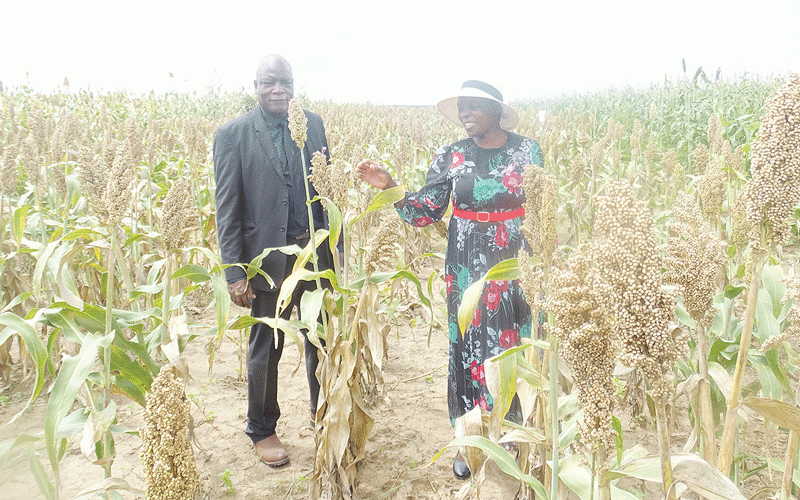
Nhlanganiso Khabo, working alongside his wife Sibongile, is among 30 farmers participating in a sorghum research and production programme spearheaded by the International Crop Research Institute for the Semi-Arid Tropics (ICRISAT).
The couple, from Dabula West village in ward 16, has established six experimental plots to test different farming methods and determine the one that produces the best yields under local conditions.
Each plot was planted on the same day, but treated differently.
One combines manure and fertiliser, another uses manure only, while others test fertiliser alone, intercropping with beans or groundnuts and a control plot with no inputs.
Despite early challenges, such as poor germination in one plot due to unsuitable soil the couple remains optimistic.
“This is a learning journey for us. We wanted to see with our own eyes what works best in our soil,” Khabo said.
“Even with the setbacks, the differences between the plots are already clear and it gives us hope for better harvests in future.”
- Ex-cop leads farming transformation in Bubi
Keep Reading
He expects a harvest of between five and six tonnes of sorghum from the field, a significant yield that can boost household income and food security.
A recent field day held at the couple’s homestead attracted farmers from across the ward with seven local farmers participating in the programme.
The couple was recognised as the best farmers in the ward, walking away with prizes that included a wheelbarrow, a hoe and two goats.
The initiative, supported by the Australian Centre for International Agricultural Research, goes beyond crop production.
It promotes agroecology and circular farming practices, ensuring by-products are reused efficiently.
Crop residue is fed to livestock, manure is returned to fields as fertiliser and innovative solutions such as producing feed from black soldier fly larvae are being introduced.
ICRISAT mentored over 60 agribusinesses, helping young entrepreneurs to develop business plans, access finance and create value-added products from sorghum and other crops.
In addition, ICRISAT has trained small grain thrashers in the area to support post-harvest handling and value chain development.
One of the thrashers, Reuben Khabo, has formed a company that provides sorghum threshing services in the community.
The company charges US$25 per tonne.
Reuben said demand for threshing services was increasing as more farmers adopt small grains but they are appealing for access to cheaper threshing machines to meet the growing need.
“Some farmers are now producing food products, livestock feed, and other goods from what was previously considered waste,” said Angeline Mujeyi, ICRISAT business development lead.
District agricultural extension officer Josphat Kujinga praised the initiative for being transformative.
“This programme is a game-changer for our farming communities. It is not only improving yields but also equipping farmers with knowledge and business skills,” he said.
According to Mujeyi, the programme supports 90 lead farmers across Insiza and Bubi districts, who are helping to spread the gospels of conservation agriculture, intercropping and value-addition techniques.