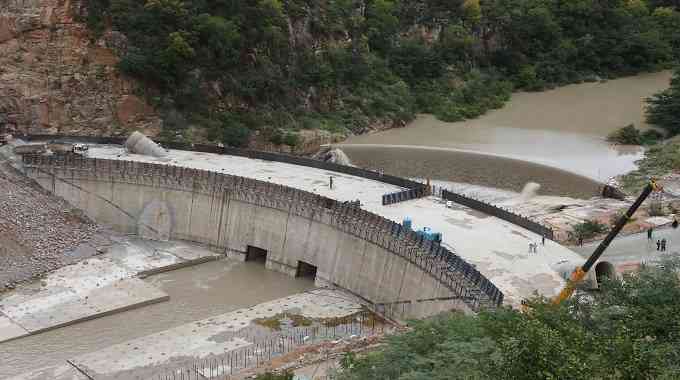
THE government, working with development partners, is rolling out a medium-term solution to Bulawayo’s long-running water challenges through the construction of Glass Block Dam in Filabusi, a project conceived in the 1950s.
Valued at approximately US$100 million, the project is a partnership between the government and development partners and is expected to ease pressure on the city’s overburdened water sources.
The project has faced multiple delays due to bureaucratic hurdles, lack of funding, and complications in securing partnerships.
The revival of the Glass Block Dam project comes as Bulawayo continues to grapple with chronic water shortages, with authorities turning to long-delayed infrastructure schemes to provide medium-term relief while the larger Gwayi-Shangani Dam remains the city’s long-term solution.
Local Government and Public Works deputy minister, Albert Mavhunga, said the project did not replace the Gwayi-Shangani initiative, which is seen as a long-term solution to Bulawayo’s water woes.
“It reflects government’s continued efforts to address Bulawayo’s water challenges and speaks to the second republic’s vision of leaving no place and no one behind,” he told journalists during a site tour.
Engineers are conducting a technical assessment at the site as the long-awaited project transitions from planning to implementation.
Glass Block Dam consortium civil engineer Michael Peto said the project would bring significant relief to Bulawayo’s strained water supply system.
- Binga villagers dig in over relocations
- Concerns grow over fate of Binga villagers
- Villagers’ relocation to cost US$2m
- Binga villagers dig in over relocations
Keep Reading
“This dam will provide medium-term relief to Bulawayo’s water crisis. It is going to be a major project with a pipeline stretching more than 30 kilometres,” he said.
The dam contractor James Goddard said, “The Bulawayo water crisis has persisted for many years. This dam is projected to supply 68 megalitres of water per day to the city.”
Community members have welcomed the initiative, expressing optimism that it will enhance livelihoods and improve agricultural productivity.
“We will now be able to practise farming because this is a dry region,” Nqobile Magwizi said.
A community member noted that livestock will benefit from improved access to water.
The project is being implemented alongside the ongoing Gwayi-Shangani Lake project, which remains the long-term solution to the city's water challenges.
According to council, the dam, with a holding capacity of 130 million cubic metres, has the potential to supply 70% of the water needed in the city.
It has been identified as a medium-term solution to the Bulawayo’s water woes and will usher in rural industrialisation through irrigation.
No major dam has been built for Bulawayo since 1975.
The city’s existing water supply dams were constructed during the colonial era: Lower Ncema (1943), Umzingwane (1956), Inyankuni (1965), Upper Ncema (1974) and Insiza (1975).
Over the years, the Bulawayo City Council has repeatedly requested that the city be declared a water shortage area. Such a designation allows it to mobilise external funding for short- to medium-term water projects aimed at alleviating shortages.