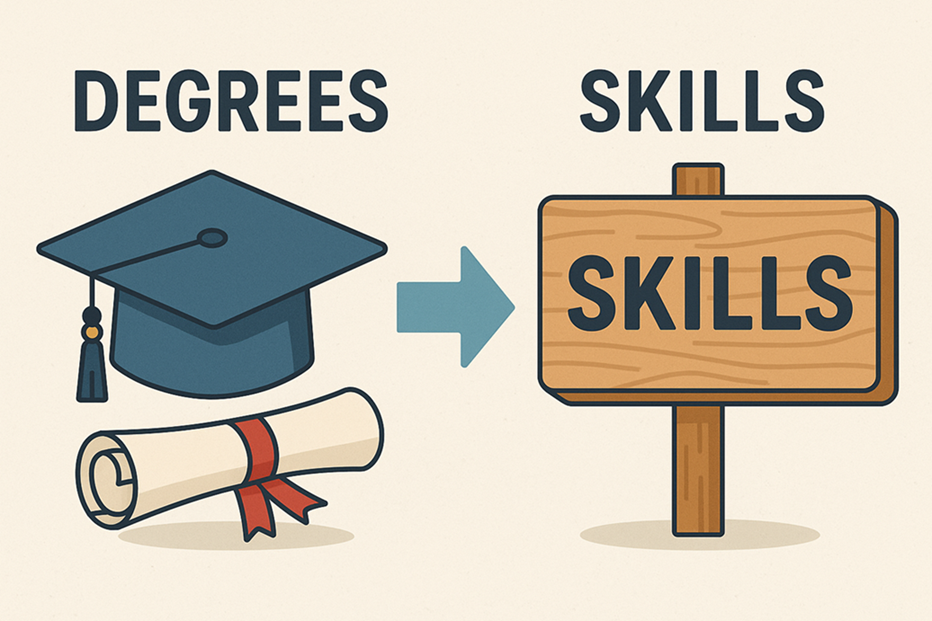
Themba graduated with a 2.1 in Business Administration. He spent eight months sending applications.
He attended three interviews. Each time, the feedback was the same: strong academic record, but not quite what we are looking for.
What they were looking for, he eventually discovered, was someone who could manage a spreadsheet beyond basic addition, run a simple data report or operate a customer management system. Nobody had taught him any of that. Four years of university and nobody had taught him any of that. Themba is not a failure. He is a symptom.
Across sub Saharan Africa, youth unemployment sits above 60% in several countries when you include underemployment graduates and school leavers working jobs that bear no relationship to their training or aspirations.
Zimbabwe’s own figures reflect this reality. We have no shortage of young people. We have no shortage of ambition. What we have a shortage of is the bridge between academic learning and the practical digital competencies that the modern economy demands.
The World Economic Forum estimates that by 2027, 44% of core job skills will be disrupted by technology. Roles that exist today will be redefined. New roles will emerge that have no textbook yet written for them. The young person who survives this disruption will not be the one with the most certificates.
It will be the one who can adapt, learn fast and work confidently with digital tools. That person does not appear automatically. They are built through deliberate investment in relevant digital education.
Spend an afternoon with any hiring manager in Harare or Bulawayo and you will hear variations of the same complaint.
- Open letter to President Mnangagwa
- Feature: ‘It’s worse right now than under Mugabe’: Sikhala pays the price of opposition in solitary cell
- Masvingo turns down fire tender deal
- Human-wildlife conflict drive African wild dogs to extinction
Keep Reading
They want young people who can use productivity software fluently. They want someone who understands basic cybersecurity hygiene because one careless click on a phishing email can cost a company weeks of recovery time and significant financial loss.
They want someone who can interpret a data dashboard, communicate professionally over digital channels and navigate cloud based collaboration tools without requiring three days of handholding.
None of these are exotic requirements. None of them demand a computer science degree.
They are, however, the difference between a candidate who gets hired and one who does not.
The uncomfortable truth is that many of our educational institutions are still preparing young people for an economy that existed 20 years ago. The curriculum has not kept pace.
The lecturers, through no fault of their own, are teaching what they were taught. Meanwhile, the workplace has moved on entirely.
A 22-year-old in Gweru is learning cybersecurity fundamentals online and landing remote freelance contracts that pay in foreign currency.
A school leaver in Mutare is building e-commerce stores for small businesses, charging in USDT and earning more than many university graduates in formal employment.
This is not the exception. It is becoming the pattern. And it is a powerful signal to institutions, employers and parents about where the real value is shifting.
Three things need to happen urgently. First, digital skills training must be embedded into every level of education not as an optional computer studies elective, but as a core competency woven into every subject.
Learning to analyse data is not just a technology lesson. It is a mathematics lesson, a business lesson and a life lesson.
Second, the private sector must stop waiting for perfect candidates and start investing in building them.
Internship programmes, apprenticeships and structured on the job digital training are not acts of charity. They are talent pipelines.
The companies that build those pipelines today will not be scrambling for skilled staff in five years.
Third and most importantly, every young person reading this must understand something clearly: the barrier to acquiring digital skills has never been lower. The internet is a library. The courses are available. The certifications are recognised. The only thing standing between where you are and where you need to be is the decision to start.
Themba eventually learned data analysis through a free online course. It took him six weeks. He is now employed. His degree did not get him the job. His skills did.
*Wilfred Munyaradzi Kahlari is a cybersecurity expert, software developer, and consultant at Kingwil Consultants. He works with boards, government institutions and businesses to strengthen digital governance and build resilient technology frameworks. For engagements: [email protected] | +263 772 212 796.