BULAWAYO has unveiled an ambitious plan to transform its informal trading sector into a network of modern, fully serviced markets.
The Highlanders vendors’ centre has been earmarked as the pilot project for what city authorities hope will become a citywide overhaul of informal trading spaces.
The initiative, which seeks to replace basic open-air vending sites with structured, covered markets offering improved amenities, is being kick-started by a US$200 000 grant from the Swiss government.
Bulawayo Mayor David Coltart said the long-term vision is to develop safer vending spaces with running water, modern ablution facilities, solar-powered electricity, and Wi-Fi connectivity.
“My vision is markets that are totally covered, protecting vendors and customers from the sun, rain, heat, and cold,” Coltart said.
“We want proper infrastructure that is easy to clean and provides dignity for traders”.
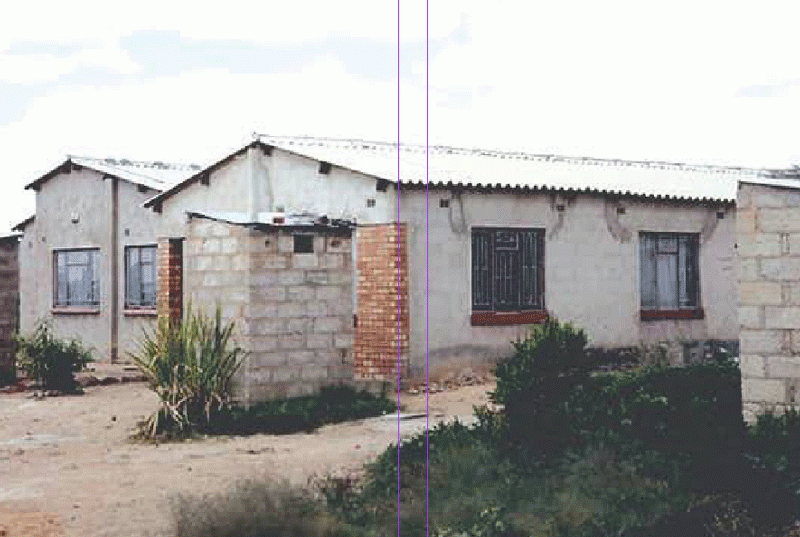
The Highlanders vendors’ centre has been selected as the first site because it already has a concrete base and existing toilet facilities. Coltart said the first stage of the project will involve roofing approximately one-fifth of the market before expanding the development in phases as additional resources become available.
“The idea is to begin with a section that we can fully roof, and then progressively expand as more resources become available,” he said.
- Revisiting Majaivana’s last show… ‘We made huge losses’
- Edutainment mix: The nexus of music and cultural identity
- ChiTown acting mayor blocks election
- Promoter Mdu 3D defends foreigners 30 minute set
Keep Reading
The Mayor said the Highlanders project is intended to serve as a model for similar developments across the city, including at Egodini, the Baktus informal trading area on Second Avenue, and Lobengula Street. The broader redevelopment programme forms part of the city’s efforts to create orderly, resilient, and better-serviced trading spaces as Bulawayo’s informal economy continues to grow.
Coltart said the Swiss funding followed a relationship that initially centred on technical discussions around the rehabilitation of the historic Bulawayo City Hall clock, which incorporates Swiss clock technology.
“This has helped us significantly, including providing information for our investigations into the rehabilitation of the Bulawayo City Hall clock,” he said.
According to Coltart, discussions with Swiss officials later expanded beyond heritage preservation after they became aware of Bulawayo’s broader urban renewal plans, culminating in the grant for the Highlanders market project.
While the current funding is limited to the pilot phase, the mayor expressed hope that successful implementation could strengthen Bulawayo’s case for future international partnerships.
“There is no Swiss investment in Bulawayo at present beyond this grant, but if we implement this efficiently, it could encourage further engagement,” he said.
He said future collaboration could extend beyond infrastructure to tourism and investment, noting Bulawayo’s proximity to attractions such as Matobo National Park and the region’s wildlife reserves.
Coltart said they are hopeful that the Highlanders development project will demonstrate a new model for informal trading that prioritises safety, improved public health, and greater dignity for thousands of vendors who sustain the city’s economy.