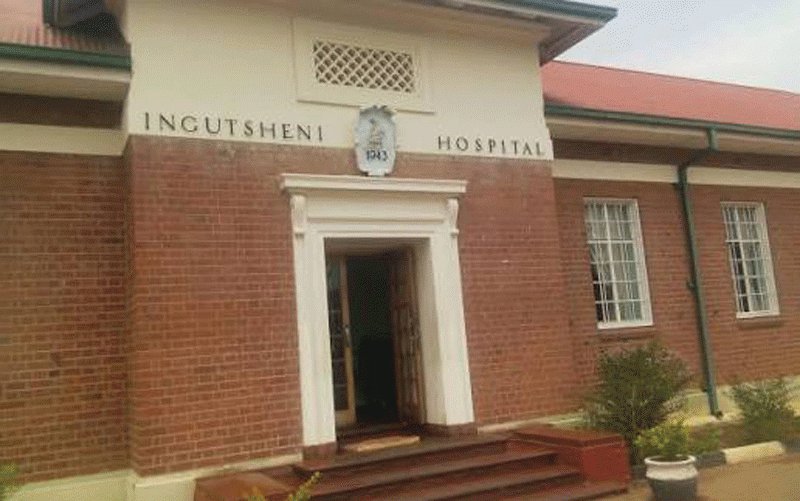
Ingutsheni Central Hospital’s acute psychiatric wards are operating at almost twice their designed capacity, despite 68 vacant beds remaining available elsewhere in the institution.
The development has exposed a capacity paradox in which available beds cannot simply be used to relieve overcrowding.
The hospital has a total bed capacity of 708 and a current patient population of 645, giving an overall occupancy rate of 90.4 per cent.
But the overall figure masks severe congestion in acute wards, such as Khumalo, Mzilikazi and Mambo, which together are accommodating 298 patients against a combined capacity of 180.
This means the three wards are carrying 118 patients above their combined capacity, according to figures verified with Ingutsheni’s chief medical officer, Nemache Mawere.
Khumalo ward is the most overcrowded, with 186 patients against a capacity of 95 — translating to 195.8%occupancy.
Mambo has 59 patients against a capacity of 40, giving an occupancy rate of 147.5 %, while Mzilikazi has 53 patients against a capacity of 45, representing a 117.8 % occupancy rate.
Despite the 68 vacant beds available elsewhere in the hospital, patients cannot simply be moved to those spaces because of their clinical needs and the security requirements of acute psychiatric care.
- Abafana bakaMzilikazi ventures into African disco
- Deutsch Connect partners local college
- Deutsch Connect partners local college
- Prince seeks to follow in Peter Ndlovu's footsteps
Keep Reading
Mawere said the affected patients were acute, vulnerable cases who required close monitoring in secure wards.
“These are acute and vulnerable patients who require close monitoring in secure wards,” Mawere said.
He said the other wards with available beds were open, making them unsuitable for acute patients.
“Other wards are open wards, and transferring acute patients there poses a high risk of elopement or escape,” Mawere added.
The result is a situation where Ingutsheni has vacant beds hospital-wide, while some of its most specialised wards remain heavily overcrowded.
This pressure comes as the hospital continues to manage substance abuse-related cases.
Figures supplied by Ingutsheni show that substance abuse accounted for 64 of the 111 total admissions recorded in January, 65 of 108 in February, 56 of 97 in March, 52 of 95 in April, 53 of 109 in May, 43 of 86 in June, and 60 of 104 in July.
In August, the hospital had recorded 40 substance abuse-related admissions by the time of reporting.
These figures amount to 393 substance abuse-related admissions between January and July, with males accounting for the majority of the recorded cases.
The hospital noted that substances being abused include crystal methamphetamine, cocaine, marijuana, codeine-containing cough syrups, diazepam, chlorpromazine (CPZ), Benzexol, alcohol and nyaope.
The hospital’s figures show that substance abuse-related admissions fluctuated during the first seven months of the year, peaking in July with 60 cases.
Mawere said the hospital was, nevertheless, continuing to improve services despite the pressure.
“We continue to be innovative, and we are giving better service,” he said.
He said essential medicines were fully available, while food and social amenities were improving.
“Essential medications are at 100%; food and social amenities are improving,” Mawere said.
The hospital is also preparing to begin a refurbishment programme and has appointed a new psychiatrist, which Mawere said was already improving supervision and patient care.