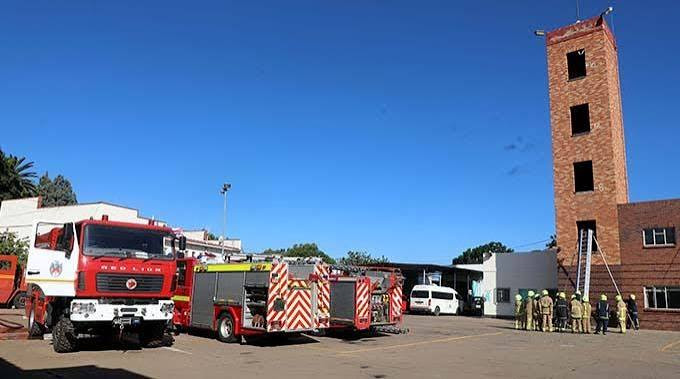
Bulawayo firefighters are racing against flames, but increasingly they are being held hostage by traffic as motorists ignore sirens, block fire engines and fail to give emergency crews the right of way.
The result, chief fire officer Mhlangano Moyo warned, is that precious minutes are being lost when firefighters are responding to emergencies where every second can mean the difference between saving lives and arriving too late.
Moyo told Southern Eye that firefighters experienced the problem first-hand when they responded to a fire at a multi-storey building in the city centre last week.
The distress call came at about 1.15pm and firefighters managed to reach the scene within five minutes, but Moyo said they could have arrived in roughly three minutes had motorists cleared the way.
“When we received a distress call at around quarter past one, yes, we managed to get there in time, around five minutes we were there, but our time was going to be much better if the motoring public had given way to our vehicles,” Moyo said.
He said traffic congestion at the George Silundika and Robert Mugabe Road intersection slowed the fire engine despite its sirens and flashing lights being activated.
“Starting from George Silundika and Robert Mugabe, there was a traffic jam, with our sirens on, flashers, we had to maneuver up to Leopold Takawira, it was a tough time, but we finally got there within five minutes,” he said.
Moyo said the journey from Famona Fire Station, near the International Trade Fair of Zimbabwe, should normally take only about three to four minutes during an emergency.
- Treger Products renovates Famona Fire Station
- Fire guts Bulawayo Polytechnic
- Train carrying 450k litres of diesel crashes at Mpopoma train station
- Bulawayo on high alert for floods
Keep Reading
“If it was not for the traffic jam or stubborn driving within the roads, we were going to take about three minutes to get there from Famona station, just opposite ZITF. It’s about three to four minutes drive if it’s an emergency vehicle en route to a fire incident,” he said.
The chief fire officer further noted that the problem went beyond congestion, with some motorists simply failing to respond appropriately when emergency vehicles approached.
“What we have since noted is the poor driving discipline,” Moyo said.
“So, what actually happens on poor driving discipline, some motorists will continue to drive, just ignore, or fail to move to the side, or at times you find that they just block the fire engine.”
The chief fire officer said the behaviour could be linked to several factors, including ignorance of emergency procedures, poor driving discipline and failure to appreciate the urgency of emergency calls.
Moyo said motorists should understand that emergency vehicles must be given priority, even if it means inconveniencing other road users for a few seconds.
“Some drivers do not appreciate an emergency vehicle. They don’t give that priority. Just to give it priority, just for seconds,” he said.
For firefighters, those seconds matter.
A fire can spread rapidly, turning a relatively contained incident into a major disaster, while people trapped inside burning buildings may have only a limited window in which they can be rescued.
Moyo said the public should therefore see emergency vehicles as part of the life-saving chain rather than simply another road user demanding space.
“We urge the community to assist us and give precedence to our vehicles so that we get there in time, we save lives. Our vehicles are meant to save life and property, whether it’s an ambulance, a fire engine,” he said.
The challenge is not confined to fires.
Moyo said Bulawayo’s emergency crews also respond to road traffic accidents, where cooperation between emergency services can improve response times.
“When we attend road traffic accidents, we normally get assistance of the police because they will be also en route to the incident. So when we move as a convoy, it becomes a little bit better,” he said.
He urged motorists to immediately give way when they see flashing emergency lights or hear sirens.
“We are urging the community of Bulawayo to try and assist the fire engines when they are en route to these incidents. Just give them way, or give precedence so that we maneuver, and at the same time, we get there in time, save life and property,” Moyo said.
As Bulawayo grows busier and congestion increases on its roads, the fire service says motorists have a responsibility to ensure that the road does not become another obstacle between emergency crews and people fighting for their lives.