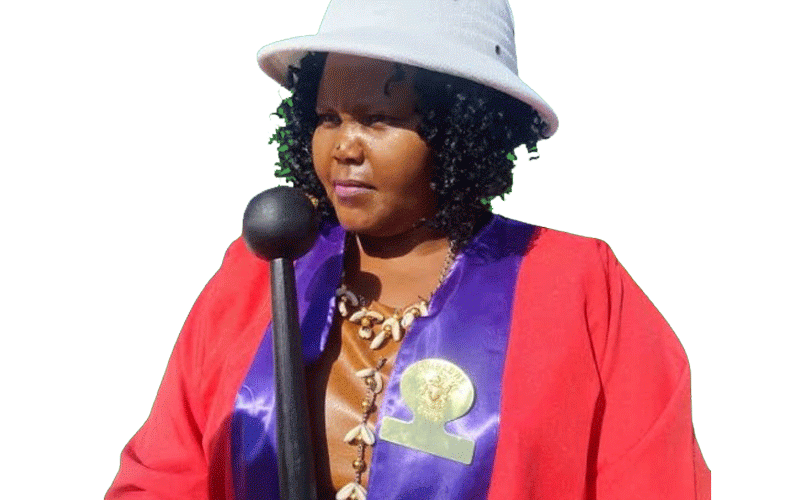
The Progressive Alliance of Mthwakazi Unions (PAMU) has lodged a formal complaint with the Zimbabwe Human Rights Commission (ZHRC), Broadcasting Authority of Zimbabwe (BAZ) and African Commission on Human and Peoples’ Rights (ACHPR), challenging what it describes as the exclusion of Matabeleland and other minority linguistic groups from recently announced public broadcasting board appointments.
In a letter dated September 7, PAMU president Cosmas Ncube accused the authorities of perpetuating structural and regional imbalances through what he described as “unconstitutional, marginalising and mono-ethnic board appointments” in the public broadcasting sector.
PAMU said the composition of the boards failed to reflect Zimbabwe’s demographic, cultural and linguistic diversity.
“The composition of these governing structures remains systematically skewed. It fails to reflect the demographic and cultural configuration of Zimbabwe,” Ncube wrote.
The organisation called on the three institutions to intervene, arguing that the alleged exclusion perpetuated historical imbalances and created institutional barriers for professionals from Matabeleland and other minority communities.
PAMU said the appointments violated several provisions of the Constitution, including Section 3(1)(b), which recognises the diversity of Zimbabwe’s people, and Section 18(2), which provides for fair representation of Zimbabwe’s regions and linguistic groups in public institutions and parastatals.
The organisation also invoked Section 56, which provides for equality and protection against discrimination, arguing that the alleged exclusion of qualified professionals from Matabeleland amounted to institutional discrimination.
It further cited Section 61(4)(b), which requires state-owned media to be impartial and afford fair opportunities for the presentation of divergent views.
- Why newly-licensed radio stations face bleak future
- Why newly-licensed radio stations face bleak future
- Why newly-licensed radio stations face bleak future
- Rights Bill to be aligned to Constitution
Keep Reading
“Impartiality cannot be achieved when the governing architecture lacks structural plurality,” PAMU said.
The organisation also alleged that the appointments were inconsistent with Zimbabwe’s obligations under the African Charter on Human and Peoples’ Rights.
It cited Articles 2, 13(2) and 19 of the Charter, which deal with non-discrimination, equal access to public service and equality of peoples respectively.
PAMU argued that continued exclusion of professionals from particular regions could create barriers to participation in national institutions.
“Centralising state media control under a single linguistic identity constitutes cultural domination,” the organisation said.
The organisation said public broadcasters had a national responsibility because they were funded through revenue collected from citizens across the country.
“When national boards are structured to lock out representation from Matabeleland, it acts as a permanent ceiling on the cultural, cognitive and economic capital of the region,” PAMU said.
It warned that such perceived exclusion could fuel regional alienation and undermine efforts towards national integration.
PAMU is now calling on the ZHRC to investigate what it described as a lack of regional and linguistic balance in public parastatal boards.
It also wants BAZ to review compliance with national diversity requirements applicable to public broadcasting entities.
The organisation further asked the ACHPR to record what it described as systemic marginalisation as part of its human rights monitoring mechanisms concerning Zimbabwe.
PAMU also called for the appointing authorities to make adjustments to ensure greater regional representation.
“True peace and national integration cannot be achieved through structural exclusion,” Ncube said.
The complaint comes amid continuing debates over diversity, representation and access to broadcasting platforms in Zimbabwe, particularly regarding the recognition of communities defined by language, culture and shared interests.