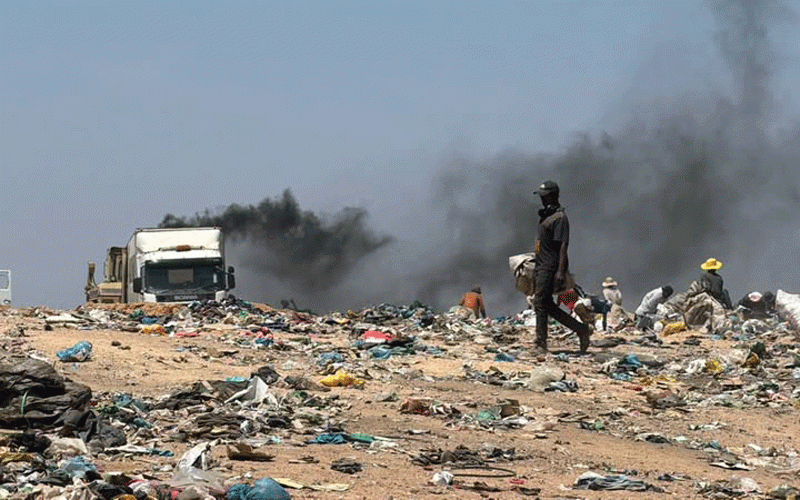
The smoke rising from Richmond Landfill has become a familiar sight for residents of Cowdray Park.
So, too, has the litter that blows from the dumpsite into their streets, and the respiratory complications they associate with years of exposure.
But when residents of Ngozi Mine – the community that has grown up on and around the landfill – finally faced their neighbours in a structured engagement last week, the conversation revealed a crisis far more complex than a simple dispute over who is to blame.
The tour, organised by the Zimbabwe National Organisation of Associations of Residents Trust (ZNOART), was prompted by concerns raised by its Bulawayo structure.
It brought together Ngozi Mine residents and representatives of Cowdray Park, with both groups airing long-standing grievances over the environmental and humanitarian crisis at the dumpsite.
What emerged was a picture of two communities suffering from the same poorly managed waste disposal system, yet increasingly pitted against each other.
As residents pointed to smoke and litter drifting towards their homes, the wind carried visible evidence of their concerns across the meeting.
Some Cowdray Park residents arrived as a group to a gathering where both communities had genuine grievances, but where Ngozi Mine residents appeared less prepared to articulate their concerns collectively.
- Female squatters plead for GBV lessons
- Ngozi miner bear brunt of breakdown of social fabric
- Cops brutalise Ngozi Mine woman
- Bulawayo City contains choking Ngozi Mine fires
Keep Reading
ZNOART national chairperson Shalvar Chikomba used the occasion to reject the characterisation of Ngozi Mine residents as squatters.
"It is very disturbing to see how some of my brothers and sisters are living here, and us calling them squatters is very inhumane because we are all Zimbabweans," Chikomba said.
He revealed that ZNOART had previously written to the government calling for intervention and wanted the Bulawayo City Council, the government and Geo Pomona Waste Management to work together in finding a solution.
Chikomba said the proposed involvement of Geo Pomona should address the welfare of people already living and working at the landfill, noting that the company had indicated it would give first priority to residents in terms of jobs.
For Ngozi Mine residents, however, the dispute over responsibility for the fires is deeply personal.
Limukani Sibanda, who said she had lived at the site since 1994, grew up there after her mother, who had a disability, settled at the former mine.
"I have stayed here since 1994 and we have experienced the smoke you are talking about,” Sibanda said.
“We also have the same children you are mentioning and they are suffering too.”
She said she had previously applied for a housing stand and paid US$50 after residents were issued with stand numbers, but had never received the promised allocation.
"In 2013, some people came and took our forms for housing," Sibanda said.
"They asked us to pay US$50 and gave us stand numbers, but up to now we have not received them, and we have proof that we paid."
Waste picking had become a livelihood for generations of residents, she added, appealing for alternative accommodation and employment opportunities.
"We are asking for a place to stay. We are asking for the promised stands because we need them,” Sibanda said.
Another resident, Collen Moyo, who said he had lived at Ngozi Mine for almost 26 years, rejected suggestions that residents were responsible for the fires, attributing them instead to poor waste management and the failure to properly bury and compact waste.
"When the litter comes here, a machine runs on top then it is buried under the soil," Moyo said.
"The only thing that causes these problems are the phone batteries that we use at home."
Moyo argued that residents should not be treated as the source of a problem that had developed over many years.
"There is no one to blame because we are a chain contributing to the problem and the solution is finding a way to dispose of the root cause," he said.
Cowdray Park residents' representative David Ndebele said his community had also suffered from the landfill's poor management and should not be forced to choose between demanding action and blaming Ngozi Mine residents.
"It was not supposed that the litter we gathered in our houses and packaged to be brought here should be left in the open like this. All this shows that there is no proper management," Ndebele said.
He said residents had previously petitioned authorities demanding either the relocation of the dumpsite or proper management.
"These papers come back to us in the communities, so what is the point of having refuse collection?" he asked.
Ndebele also called for free treatment for Cowdray Park residents who develop respiratory problems.
"Our main concern was that every Cowdray Park resident who is found with chest complications should be treated free, because we are being charged large sums of money, suffering over something done deliberately," he said.
Another Ngozi Mine resident, Gideon Tshuma, said the landfill had changed significantly since the 1990s, when it was a deep mine, and argued that current conditions could not simply be attributed to people living at the site.
"As from 1994, it was deep," Tshuma said.
"Today we just see everything being dumped anywhere.
"Years before, we did not have fires, but now we are experiencing them because of many reasons, including poor management.
"Some fires are 10 years old, so Cowdray Park should not be blaming us or putting us as the causes of the fire. We cannot burn where we benefit."
The engagement comes amid a broader dispute over the proposed involvement of Geo Pomona Waste Management.
Local Government and Public Works minister Daniel Garwe directed the council on September 10 to engage the company and conclude an agreement within a week, a directive issued while the council was pursuing its own procurement process for a private waste management partner.
The council had received three compliant bids in October 2025, which were submitted to the Procurement Regulatory Authority of Zimbabwe (PRAZ) and the Zimbabwe Investment and Development Agency (ZIDA) for consideration.
The local authority also submitted a pre-feasibility study to ZIDA on June 23, 2026, for consideration by the public-private partnership committee, which was scheduled to deliberate on the proposal on September 8.
While the council awaited feedback, Garwe directed it to engage Geo Pomona.
The council has since resolved to proceed with engagement while seeking a draft agreement for consideration by councillors.
Former Zipra combatant and intelligence officer Prince Solengwe Tshawe kaNonxoloba, who is also a prince of the Xhosa people, questioned the government's directive, arguing that the local authority should be allowed to pursue its own procurement process and develop a locally driven solution.
Tshawe questioned whether the proposed arrangement would result in significant expenditure by the council at a time when the local authority was facing financial constraints.
He said the council should instead consider companies and people already operating in Bulawayo.
"Some of us have companies to collect all this refuse and other companies, people we know, where we can actually form associations or groups to actually get all this refuse from dump sites within the areas designated by council and take that refuse to the dumpsites in Ngozi Mine," he said.
Tshawe said he had previously submitted a proposal to the council for the establishment of incineration facilities and a biogas project at Ngozi Mine, proposing that waste collected across the city be processed at the landfill to generate energy.
"The collection of the refuse should go to Ngozi Mine where there should be incinerators where they can actually be burnt and produce energy in the form of maybe biogas, electricity and whatever," he said.
Tshawe said the government should encourage the council to accelerate such initiatives instead of directing it towards a particular company.
"The minister must be encouraging the council to speed up that process rather than say he now wants another company. What is his interest in that company?" Tshawe said.
"The council has engineers, it has accountants, all capable people who are actually looking into this thing."
He also raised concerns about employment opportunities, arguing that Bulawayo residents should benefit from the intervention.
Tshawe questioned the implementation of devolution, arguing that local authorities should have greater control over decisions affecting their communities.
He also questioned what he described as the failure of local authorities to take greater initiative.
"The town clerk must also stand up and see that such projects are not hijacked by other people at the expense of the local people from Bulawayo," he said.
Coltart said the council had fully complied with the country's laws and its own regulations.
"BCC has fully complied to date with all Zimbabwe's laws and BCC by-laws and policies," Coltart said.
The council has previously said any arrangement with Geo Pomona would have to comply with the relevant legal and financial requirements, including the Urban Councils Act, Public Finance Management Act and ZIDA Act.
Both communities' concerns remain unresolved, with residents on either side of the dumpsite now waiting to see whether the planned Geo Pomona takeover and government intervention will deliver the jobs, housing and health relief they have demanded.
ZNOART said it would compile its observations and recommendations from the tour and submit them to the relevant authorities