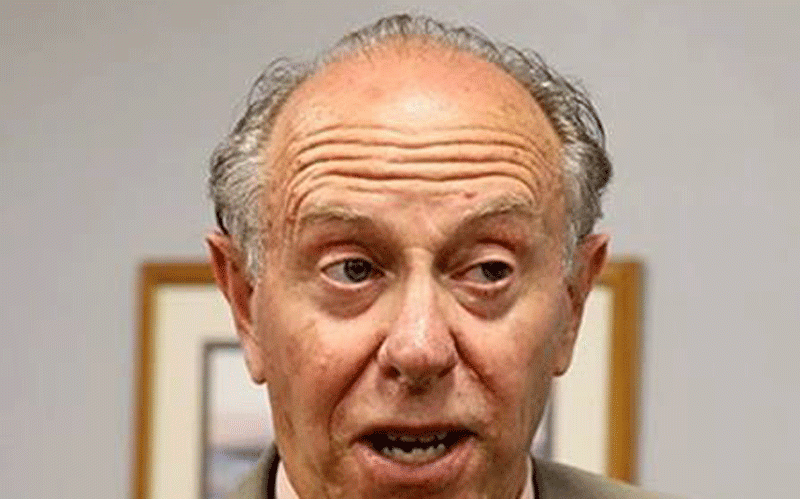
BULAWAYO faces another potentially severe water crisis if the coming rainy season fails to adequately replenish its supply dams with mayor David Coltart warning that the city urgently needs the rehabilitation of the Ncema system, construction of the long-delayed Glassblock Dam, and an end to mining activities threatening its water catchments.
Coltart said the government’s continued focus on the construction of the Gwayi-Shangani Dam was not enough to solve the city’s immediate water problems because the city will only benefit once the 252-kilometre pipeline to Bulawayo and associated infrastructure are completed.
“We desperately need the rehabilitation works done at Ncema, Glassblock constructed and the mining in our rivers stopped,” he told Southern Eye on Sunday.
“If we have drought this coming rainy season we will face another major water crisis.”
Coltart said the pace of funding for the Gwayi-Shangani-Bulawayo pipeline raised serious questions about when the project would actually begin supplying the city.
“Government keeps speaking about Gwayi Shangani but little progress has been made on the 252 km pipeline,” he said.
“The July Zinwa report stated it will cost $543 million to build. “Last year government allocated $2,5 million.
“At that rate Bulawayo will get water from Gwayi Shangani in 217 years time — the maths is clear, 543 divided by 2.5 is 217.”
- Bulawayo targets private companies for tar-making plant
- Glassblock Dam to end water woes: BCC
- Glassblock dam to solve Bulawayo’s water crisis
- Byo silences voices opposing Glassblock Dam
Keep Reading
A National Matabeleland Zambezi Water Project progress report dated July 10, 2026 put the value of four major contract packages at US$554.44 million, including the pipeline, pump stations, pipe supply, and the Bulawayo treatment plant.
The pipeline component is critical because Gwayi-Shangani Dam alone cannot deliver water to Bulawayo.
The broader project includes a 252km pipeline from the dam, pump stations, and water-treatment infrastructure in Bulawayo. Zimbabwe National Water Authority’s earlier annual reporting described the pipeline as a 252km, 1 400mm GRP pipeline with raw-water pumping infrastructure intended to supply Bulawayo and support irrigation along the route.
Coltart said the reported progress on the dam should, therefore, not be confused with progress towards securing a reliable water supply for Bulawayo.
“Look at page 15 of the report to get the cost of the pipeline. Government keeps speaking about the dam being 80% complete but for Bulawayo that is only part of the issue — Bulawayo will only benefit when the pipeline is constructed,” he said.
The city continues to rely on its existing dams and ageing water infrastructure, despite an improvement in water levels following the 2025/26 rainy season.
Bulawayo’s six supply dams ended the 2025/26 rainy season at about 70% combined storage, the strongest position recorded in years.
However, the city council subsequently maintained water shedding because improved raw-water availability has not eliminated infrastructure and production constraints.
Council figures published in May projected that, under prevailing abstraction trends, Lower Ncema could be depleted by November 1, 2026, while Umzingwane was projected to last until August 2027 and Inyankuni until August 2028.
This has kept attention on the condition of existing infrastructure.
A Bulawayo City Council document noted that rehabilitation of the Ncema pipeline had been estimated at US$14.5 million and that the work would increase the city’s water capacity.
The same council material records Glassblock as a long-running project dating back to the late 1990s, with the proposed dam having the potential to provide about 70 megalitres a day.
At the same time, mining in the catchment areas feeding Bulawayo’s dams has emerged as another threat to water security.
In January, council officials, councillors, and the media inspected Upper Ncema, Inyankuni, and Umzingwane amid concerns over mining activities in the catchment areas.
Reports from the inspection highlighted mining operations close to the reservoirs.
The government subsequently promised action against illegal and unregulated mining in water catchment areas, with Local Government minister Daniel Garwe saying authorities would enforce existing laws governing riverbed mining and environmental protection.
The Environmental Management Agency, however, has said mining operations upstream of Bulawayo’s dams had undergone the legally required environmental assessment processes before being approved, highlighting a dispute over how such activities are being regulated and their impact on water sources.
The warning over the city’s vulnerability is not new.
Agriculture and Water minister Anxious Masuku recently described Bulawayo’s water situation in historical terms, saying: “Bulawayo in 1910 the water situation in Bulawayo was described as precarious, in 2026, the water situation is described as precarious.”
Criterion Water Works superintendent Sibusisiwe Dube said the city would have sufficient water if its dams consistently filled, but drought was making that increasingly difficult.
“If all the dams could be full on a yearly basis, would be able to supply the city with water, but because of these droughts that are happening, you’ll find that at the end of any rainy season, maybe our Mzingwane is only 40% full, those are just examples and maybe Inyankuni Dam is 50% full,” Dube said.
“Mtshabezi is usually the one that gets to 100% full usually if there’s been a good rain season, because of these droughts, we hardly get to a season where we’ve got 100% capacity in our dams.”
Dube said the previous poor rain season had left the city concerned about its water position.
“Now, unfortunately, because we haven’t had a very good rainy season in the previous year, we are dreading the El Niño because our levels are a bit low,” she said.
“So we are not very sure if we’ll be able, but we are trying to conserve as much as we can, ration as much as we can so that our water can last for the longest possible period.”
The latest national dam data shows the Mzingwane catchment at 80.5% storage as of September 28, 2026, but that national catchment figure does not mean that each of Bulawayo’s individual supply dams is full.
For Bulawayo, the central question therefore remains whether the city can maintain adequate supplies from its existing system while waiting for the major infrastructure projects intended to provide a longer-term source.
The Gwayi-Shangani project has been presented for years as the long-term answer to Bulawayo’s water shortages.
The government reported in 2022 that the 252km pipeline contracts had been signed and that 68km of the route had been cleared, with six kilometres excavated.
Four years later, the pipeline remains unfinished.
For Coltart, the issue is no longer simply whether Gwayi-Shangani Dam will be completed, but whether the infrastructure required to move its water to Bulawayo will receive funding at a pace that matches the city’s water needs.