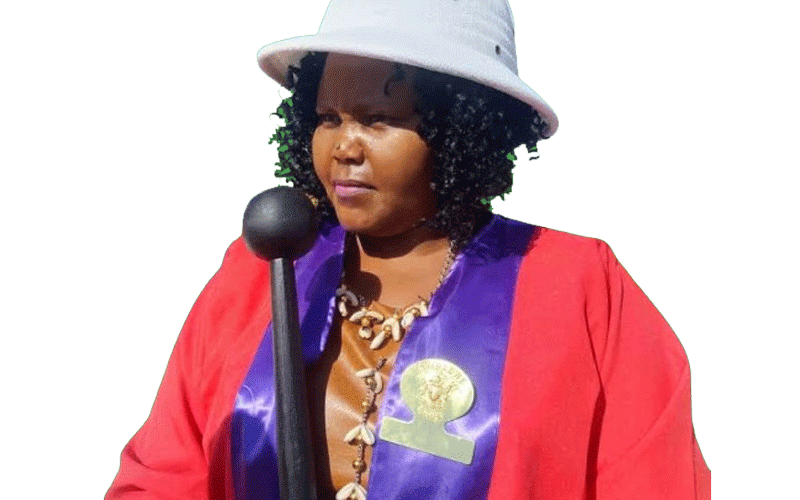
The installation of Chief Nomalanga Sigola has reignited debate over female succession in Ndebele traditional leadership, with cultural activists questioning whether the appointments preserve customary practices, while the National Council of Chiefs says the constitution takes precedence over traditions that conflict with it.
Chief Sigola was officially installed as the substantive Chief Sigola at Sigola Primary School in Umzingwane district, Matabeleland South, on October 7, almost three years after the death of her father, Chief Zephania Sigola, who died on May 1, 2023.
She became the latest woman to occupy a chiefly throne in the country, reviving questions about whether daughters can succeed their fathers, how chieftainship is preserved within a family, and whether the appointment of women represents an evolution of custom or a departure from established Ndebele succession practices.
The country's first female chief, Sinqobile Mabhena of Umzingwane, was installed in 1997 after succeeding her father, who had no son.
Her appointment encountered resistance from some traditional leaders and politicians, opening a debate that has continued through subsequent female appointments.
According to contemporary reports, Mabhena's succession was contested for several years.
The dispute revealed the difficulties women could face when seeking recognition in an institution historically dominated by men.
Since then, other women have ascended to traditional leadership positions, including Chief Ketso Mathe of Gwanda, Chief Nonhlanhla Ndube of Insiza, Chief Hikwa of Bulilima, Chief Mvuthu (also known as Silibaziso Mlotshwa) of Hwange, and Regent Chief Mabhikwa (Zanele Khumalo) of Lupane.
- Hwange villagers lose livestock to marauding lions
- Vic Falls boy survives lion attack
- Police takes crime awareness campaigns to Esigodini, Hwange
- Chief Sigola’s rise torches storm
Keep Reading
Chief Sigola's installation has been described in recent reports as making her Zimbabwe's eighth female chief, although the national count has varied in previous reports, partly because of changes in appointments and the inclusion of acting or regent chiefs.
The appointments have drawn differing responses from those who regard female succession as necessary to uphold women's equality and those who argue that chieftainship must remain governed by the particular lineage and customary succession arrangements of each chiefly house.
The president of the Mthwakazi Republic Party, Mqondisi Moyo, said the debate should distinguish between women's participation in leadership generally and their succession to specific chiefly positions.
"Ndebele history clearly demonstrates that women exercised considerable political and social authority. Queen Lozikeyi Dlodlo is an obvious example," Moyo said.
"The issue is, therefore, not whether Ndebele women can lead. They can and they have. The issue is whether a particular woman is the customary successor to a particular chiefly house."
Moyo said Ndebele chieftainship was historically rooted in lineage, genealogy, customary authority, community recognition, and ancestral obligations, rather than being an ordinary government position.
He argued that colonial rule altered and bureaucratised African institutions, while the post-independence state continued regulating traditional leadership through legislation.
"Most importantly, there was never necessarily one identical succession rule for every Ndebele chiefly house. Each case must be examined according to the history, lineage and custom of that particular community," he said.
"Customary legitimacy cannot simply be manufactured by government proclamation".
Moyo said being born a woman should not automatically disqualify a potential successor, but neither should being the eldest child automatically confer the right to a chiefly stool.
"If the family, lineage and community genuinely recognise a woman as the legitimate customary successor, that claim must be considered seriously," he said. "But there is a fundamental difference between a community legitimately developing its own custom and the state changing that custom for the community".
He said his party opposed what he described as the political capture and redefinition of Ndebele customary institutions, arguing that any changes to succession practices should emerge from the communities concerned.
He added: "We are not defending patriarchy. We are defending customary legitimacy. We are not opposing women. We are opposing state capture and the redefinition of our customs."
Ibhetshu Likazulu secretary-general Mbuso Fuzwayo also opposed female chieftaincy, arguing that Ndebele succession traditionally ensured continuity within a chiefly family even when the incumbent had no sons.
"Ndebele culture, if we talk of induna, we are talking of a male. It is against our culture, it's new but it's not clear what is the motive," Fuzwayo said.
He said chieftainship belonged to the family rather than an individual, adding that where a chief had no sons, succession could pass through a brother's line.
"Women, it doesn't matter on lineage, it is about family, if the one on the throne cannot have males, his brother will provide the heir, chieftainship is of the family not of an individual," he said.
Fuzwayo described female succession as "the rewriting or distortion of the Ndebele customs and traditions". He questioned what would happen when a female chief died and who would succeed her, arguing that the traditional practice of grooming a male heir from the chiefly family provided continuity and avoided succession disputes.
Bulawayo-based analyst Methuseli Moyo also said the terminology and historical organisation of Ndebele traditional leadership had been associated with men.
"Induna, the word, is male. Chieftaincy was associated with or restricted within males in the Nguni culture," he said.
Moyo said the convention had encouraged chiefs without sons to continue having children in the hope of producing a male heir.
He said the succession of a woman who married into another family raised questions about whether her children could inherit the chiefly position associated with her birth family.
"A woman can be married and taken away from her people. And her children will not succeed her. When she dies, there will be more confusion," he said. "Chieftainship belongs to a family or clan or community, and all steps must be taken to keep it that way".
However, Moyo said traditional leadership itself had changed under modern political and administrative arrangements.
"I think the idea of chieftainships has been modernised. Chiefs are now subservient to political power. So anything that the powers that be allow can go now," he said.
Public policy analyst Effie Ncube said the debate required consideration of developments elsewhere in Africa, where women had assumed traditional leadership positions under different customary arrangements. Ncube cited examples from South Africa, including female amakhosi in KwaZulu-Natal, arguing that experiences in other societies could inform discussion in Matabeleland without assuming that different cultures followed identical succession rules.
A 2012 report by South Africa's Independent Online documented the rise of Victoria Dube, who became the first woman to chair the uThungulu House of Traditional Leaders in KwaZulu-Natal.
The report said Dube, an inkosi of the amaKholwa community in eNtumeni, outside Eshowe, had attained her position through community elections rather than straightforward hereditary succession.
It also reported that the province had 27 female amakhosi at the time, among more than 200 traditional leaders.
The experience illustrates that women's participation in traditional leadership can take different forms, including hereditary succession, community selection, and regency.
It does not, however, establish that the same arrangements apply to Ndebele chiefly houses in Zimbabwe.
The legal framework governing the appointments is central to the current dispute. Section 56 of Zimbabwe's Constitution guarantees equality before the law and prohibits discrimination on various grounds, including sex. Section 80 further provides for women's rights, including equal opportunities in political, economic, and social spheres.
However, Section 283 specifically addresses the appointment, succession, suspension, and removal of traditional leaders.
It requires legislation governing these matters to take account of the prevailing culture, customs, traditions, and practices of the communities concerned.
The same section provides that chiefs are appointed by the president on the recommendation of the provincial assembly of chiefs through the National Council of Chiefs and the responsible minister.
It also requires safeguards against political considerations and interference in traditional institutions.
Section 281 requires traditional leaders to act in accordance with the constitution and the law, observe customs relating to traditional leadership, treat people within their areas equally and fairly, and refrain from partisan political activity.
The Traditional Leaders Act also requires consideration of the customary succession principles applicable to a community when a chief is appointed, as well as the administrative needs of the area.
These provisions place constitutional equality alongside the recognition and preservation of customary institutions. Section 56 does not itself expressly prescribe that a daughter must inherit a chiefly position, while Section 283 requires the succession process to take account of the customs of the particular community.
President of the National Council of Chiefs, Chief Mtshane Khumalo, said the constitution had changed the legal position regarding women succeeding to traditional leadership.
"If you read the constitution, Section 56 says women can also be chiefs, because the section says you must not discriminate against a person on the basis of their status, whether they are a woman or a man," Khumalo said.
He said under the new constitutional framework, where a chiefly house had daughters but no sons, a daughter could succeed to the position.
"In the Ndebele tradition, where there are only girls, they can choose among themselves who should be the first to become induna," he said.
Khumalo acknowledged that the change could be difficult to reconcile with established cultural practices.
"It's a bit challenging because it does not go along with our culture, but the Constitution is the highest law in Zimbabwe," he said. "If the Constitution says this and that, you cannot change it, even if you wish to, even if you have money, you cannot change it".
Khumalo said Chief Sigola had succeeded her father because he had no male child, adding that the appointment reflected the new constitutional environment.
The succession dispute also raises questions about how customary institutions adapt while retaining their identity and continuity across generations.
Historically, Ndebele chieftainship was overwhelmingly male-dominated. Queen Lozikeyi Dlodlo's political influence and other examples of women exercising authority in the wider Nguni cultural world demonstrate that women were not absent from political life.
However, such examples do not, by themselves, establish that women traditionally occupied Ndebele chiefly stools in the same way as male chiefs.
The appointment of Mabhena in 1997 marked a significant departure from the established pattern and set a precedent for later appointments. Subsequent disputes, including the legal contest surrounding Chief Mvuthu's succession, have shown that questions of gender, family lineage, and customary legitimacy can become protracted.
International human rights standards also recognise the importance of women's equal participation in public life.
The United Nations Convention on the Elimination of All Forms of Discrimination against Women requires states parties to take steps to eliminate discrimination against women, while the committee monitoring the convention has urged governments to address barriers to women's participation in decision-making.