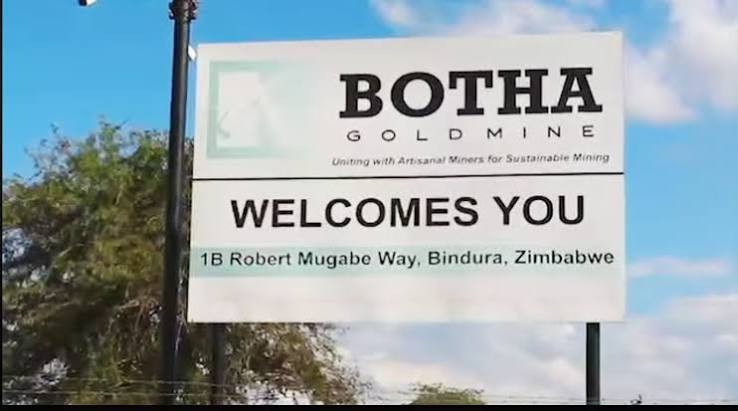
BINDURA — In Zimbabwe’s gold-rich communities, the story of mining is often told through production figures, machinery and ounces recovered. But at Botha Gold Mine in Bindura, another story is unfolding; one centred on people, opportunity and the gradual transformation of informal mining into a more structured and accountable economic activity.
Botha Gold Mine operates a contractor-based mining model that brings together hundreds of small-scale and artisanal mining operators within an organised operational framework.
For many of the men and women earning their livelihoods from mining, this represents something bigger than access to mineral resources. It is an opportunity to participate in the country’s mining economy within a system that increasingly demands greater responsibility for safety, environmental awareness, workplace discipline and operational standards.
That transformation is not always easy.
Many workers entering the sector come from informal mining environments where safety procedures, protective clothing, shaft standards and structured inspections may previously have received little attention. Botha has therefore increasingly placed compliance and behavioural change at the centre of its operations.
The mine’s current safety drive includes compulsory personal protective equipment, routine shaft inspections, dedicated compliance teams and escalating enforcement for repeated breaches.
Importantly, management says the objective is not punishment.
The greater goal is to build a culture in which miners understand that a helmet, safety boots, protective clothing or a properly maintained shaft are not unnecessary expenses; they are investments in getting people home safely at the end of the working day.
- Abafana bakaMzilikazi ventures into African disco
- Forex retention policies ruin mines
- Forex retention policies ruin mines
- Top miner evicts 10 families
Keep Reading
That philosophy is increasingly reflected in the mine’s message: “KUTERERA KUPONA… KUPONA KUTERERA” — compliance saves lives.
Beyond the mine gates, Botha’s footprint extends into the surrounding economy. Contractors employ workers, workers support families, local suppliers provide goods and services, transporters move people and materials and income generated through mining circulates through communities.
One of the mine’s contractors, John Phiri, believes the model has created opportunities extending well beyond individual contractors.
“What Botha has given us is an opportunity not only to work for ourselves, but to create employment for other people as well,” Phiri said. “There are families depending on the people working here. At the same time, we are learning that mining has to be done properly and safely. The standards being enforced today are helping us become better and more responsible miners.”
The company has also participated in community and national initiatives ranging from clean-up campaigns and school support to Workers’ Day, Africa Day, Independence celebrations and other community engagement programmes. Its commitment to education extends to Bindura University of Science Education, where Botha Gold Mine sponsors two annual academic achievement awards within the Faculty of Science Education — the Best Performing Female Student and the Best Performing Student Living with Disabilities. Two floating trophies recognise these achievements, reflecting a deliberate emphasis not only on academic excellence, but also on the advancement of women and the inclusion and recognition of students living with disabilities.
It is an approach that recognises that a mine should ultimately be measured by more than the gold it produces.
The future of Zimbabwean mining will depend partly on the country’s ability to bring historically informal economic activity into safer, more productive and more accountable structures without excluding the ordinary Zimbabweans whose livelihoods depend upon the sector.
Botha Gold Mine’s journey is therefore also a story about transformation.
There is still work to be done. Building a strong safety culture among hundreds of independent operators does not happen overnight. Neither does changing practices developed over years in the informal mining sector.
But every worker who puts on full PPE without being reminded, every shaft brought up to standard and every contractor who begins to see compliance as part of good mining rather than an inconvenience represents progress.
For Botha Gold Mine, perhaps that is the most important resource being developed in Bindura.
Not simply gold beneath the ground; but safer livelihoods, responsible enterprise and an opportunity for ordinary Zimbabweans to participate meaningfully in the country’s mineral economy.