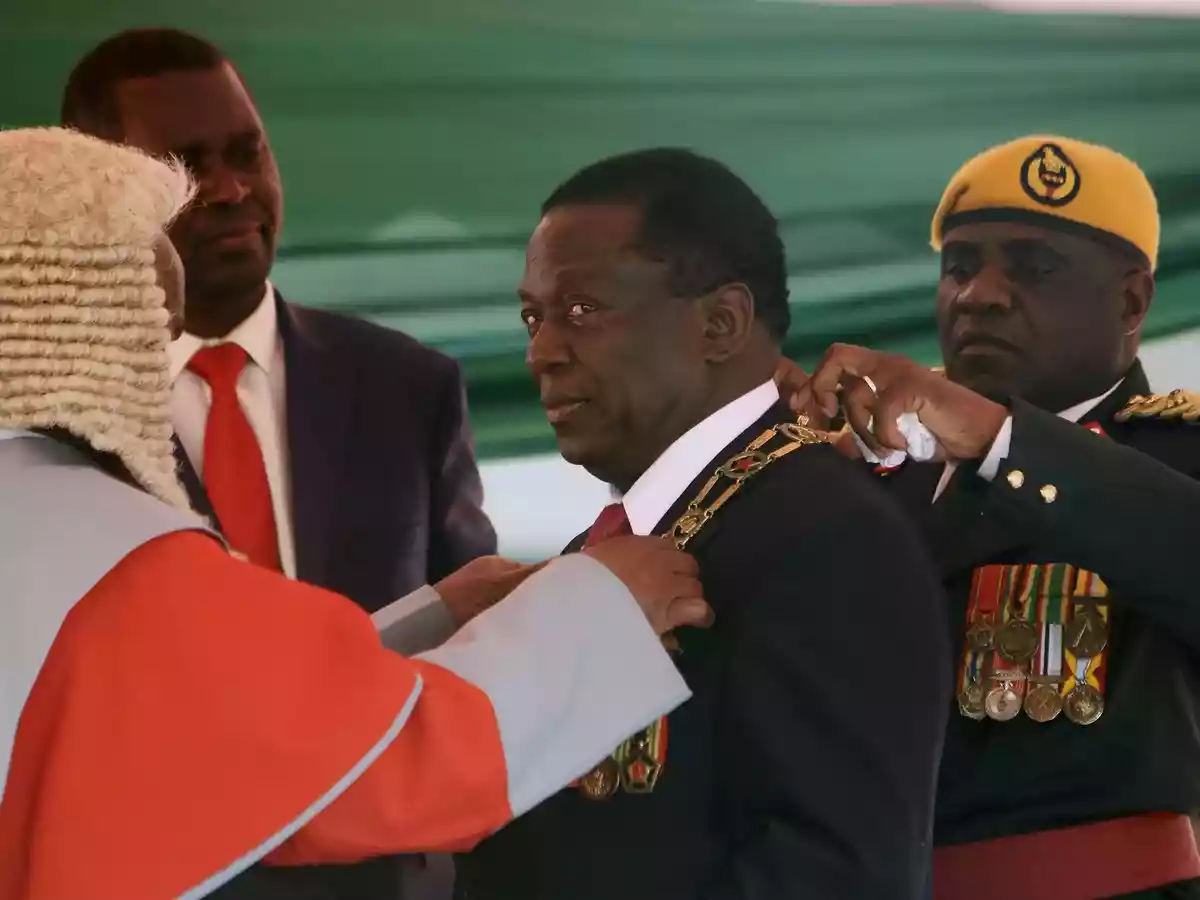
HARARE, May 15, (NewsDay Live) — At midnight on Wednesday, the constitutional clock finally ran out on Luke Malaba’s tenure as Zimbabwe’s chief justice. By Thursday morning, President Emmerson Mnangagwa had appointed Justice Elizabeth Gwaunza as his successor, making her the first woman to lead the country’s judiciary.
She assumes office with little time to settle in. In five days, the Constitutional Court is due to hear one of the most politically consequential constitutional challenges Zimbabwe has faced in years.
The appointment, announced by Chief Secretary to the President and Cabinet Martin Rushwaya, takes effect from May 15 under Section 180(2) of the Constitution. Gwaunza, 73, has served as deputy chief justice since 2018. Justice Paddington Garwe, previously a Constitutional Court judge, becomes deputy chief justice.
At a farewell sitting of the Constitutional Court on Thursday, Malaba said he was leaving office with dignity as “the bell of the Constitution” tolled at midnight.
Gwaunza praised her predecessor as “a towering figure in Zimbabwe’s legal and judicial history,” citing reforms including the digitisation of courts, decentralisation of judicial services and expanded access to justice.
Her appointment caps a legal career that began in colonial Rhodesia, where she was among the first two Black women to graduate in law from what later became the University of Zimbabwe.
Before joining the bench, Gwaunza worked extensively in women’s rights and legal reform. She co-founded the Women and Law in Southern Africa Research Project, served as director of legal affairs in the Ministry of Community Development and Women’s Affairs, and later headed legal aid in the justice ministry.
Appointed to the High Court in 1998 by then-President Robert Mugabe, she joined the Supreme Court in 2002, becoming only the second woman to sit on the country’s top bench.
- ‘Govt spineless on wetland land barons’
- SA’s search for a fairer electoral system
- SA’s search for a fairer electoral system
- Mawere demands judge’s recusal
Keep Reading
Between 2008 and 2013, she served at the International Criminal Tribunal for the former Yugoslavia in The Hague. The appointment drew scrutiny from the International Bar Association over her perceived links to Mugabe’s government, including allegations she benefited from a farm seized during Zimbabwe’s land reform programme. Gwaunza has not publicly addressed the allegation in verifiable terms.
In 2018, she became Zimbabwe’s first female deputy chief justice.
Now, almost immediately, she faces a case with major political implications.
On May 20, the Constitutional Court is scheduled to hear a challenge to Constitutional Amendment Bill No. 3 (CAB3), legislation that would replace direct presidential elections with election by Parliament, extend presidential and parliamentary terms from five years to seven, and potentially allow Mnangagwa to remain in office until 2030.
The challenge was brought by six war veterans represented by constitutional lawyer Lovemore Madhuku, who argues that the proposed changes require a national referendum because they alter presidential term-limit provisions in a way that benefits an incumbent president.
Attorney General Virginia Mabhiza has dismissed that interpretation as legally unfounded.
The bill has drawn criticism from opposition parties, church groups, civil society organisations and the Law Society of Zimbabwe. Public hearings on the legislation have also been marked by violence.
On March 31, human rights lawyer Douglas Coltart was assaulted during a parliamentary hearing in Harare while attending as an observer. Lawyers’ groups condemned the attack and international legal organisations later called on the government to protect lawyers and judicial actors. Police say a document circulating online claiming to provide an update on the investigation was fake.
Gwaunza now chairs the court that will decide the CAB3 dispute. It is not publicly known whether she will recuse herself from proceedings despite concerns among some legal observers about a potential conflict of interest, given that the proposed constitutional changes could affect judicial tenure arrangements from which she benefits.
Constitutional law scholar Justice Mavedzenge has argued that Section 328(7) of the Constitution makes a referendum mandatory if amendments extend the tenure of a sitting president. The government disputes that interpretation.
Beyond CAB3, Gwaunza inherits a judiciary facing questions over its independence and public credibility.
Prominent human rights lawyer Beatrice Mtetwa said earlier this year that Malaba’s tenure had eroded public confidence in constitutional protections and entrenched perceptions of judicial capture.
At the same time, Malaba leaves behind substantial administrative reforms. Zimbabwe’s courts completed a nationwide digital case management rollout under his leadership, expanded court infrastructure and reduced superior court backlogs by 20% in 2025, according to judiciary figures.
Gwaunza now takes charge of an institution balancing institutional modernisation against mounting scrutiny over its independence.
Her tenure begins with the country, and the Constitution, already testing it.