HARARE, Jul. 15 (NewsDay Live) – The Securities and Exchange Commission of Zimbabwe (SecZim) posted a year-to-date surplus of ZWG15,66 million for the first half of 2026, far exceeding its budgeted surplus of ZWG1,1 million, as the regulator stepped up efforts to strengthen Zimbabwe's capital markets and diversify its revenue base.
Speaking at the Commission's eighth annual general meeting, SecZim said the improved performance reflected prudent financial management, although part of the surplus was supported by a government grant received during the period.
The first-half surplus was also significantly higher than the ZWG1,3 million recorded for the full 2025 financial year.
SecZim said its cost-to-income ratio continued to improve, falling from 90% in 2025 to below budgeted levels, while the staff cost-to-income ratio declined from 50% to 38%.
The regulator said the improvement reflected stronger financial discipline but cautioned that sustaining the gains would require reducing reliance on a single revenue source.
"Our overall assessment is that the Commission remains in a sound equity position with a healthy year-to-date surplus cushion of ZWG13,7 million," it said.
SecZim said core levy income had come under pressure, largely because of changes in the securities market, including the delisting of Econet Wireless Zimbabwe. The move reduced activity within its securities database, highlighting the risks of relying heavily on one income stream and underscoring the need to diversify revenue.
Despite the challenges, the Commission said it remained financially stable, supported by healthy liquidity and government backing, while pursuing its goal of becoming a technology-driven, digitally transformed market regulator.
- In Full: eighteenth post-cabinet press briefing June 28, 2022
- Mudariki’s vision for Zim contemporary art fair
- Artist Richard Mudariki’s vision for a Zimbabwean contemporary art fair
- UK based Zimbabwean divorces wife of 33 years over conjugal rights
Keep Reading
"We must first become financially disciplined, diversify our revenue streams and rebuild our margin of safety before becoming the technology-driven regulator the capital markets deserve," it said.
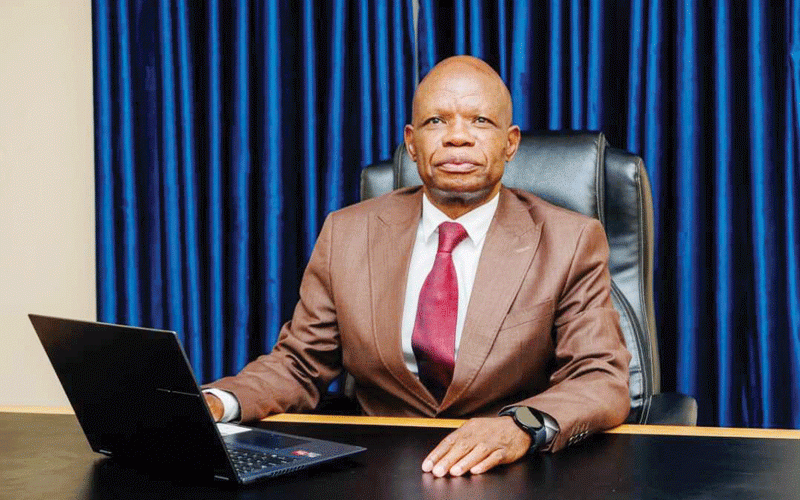
SecZim chairperson Dakshesh Patel said financial sustainability was essential for effective market regulation and pledged to accelerate reforms aimed at modernising Zimbabwe's capital markets.
He said the Commission would push for amendments to the SecZim Act to strengthen supervisory, investigative and enforcement powers, improve investor protection, enhance oversight of corporate actions and establish an appropriate regulatory framework for emerging financial products.
Patel said digital finance presented a significant opportunity for Zimbabwe, provided innovation was matched with strong regulation.
"Properly regulated tokenisation, blockchain-based products and digital assets can lower barriers to entry, broaden participation, reduce transaction costs, improve cross-border investment and create new channels through which the informal sector, young people and small businesses can access capital," he said.
He said the Commission was pursuing a regulatory framework that balances innovation with investor protection and aligns with international standards.
Patel also called for deeper and more diversified capital markets, saying Zimbabwe needed more equity listings, infrastructure bonds, green bonds, real estate investment trusts (REITs), collective investment schemes, asset-backed securities and diaspora-focused investment products to support national development.
He said the success of the capital markets should ultimately be measured by the amount of capital mobilised, businesses financed, jobs created and investor confidence generated.
Director of finance and administration in the Ministry of Finance, Economic Development and Investment Promotion, Kudakwashe Zata, said Zimbabwe could not rely solely on debt financing to meet its long-term development needs.
Instead, he said, vibrant debt and equity markets, innovative investment vehicles and stronger participation by institutional and retail investors would be critical in mobilising capital for infrastructure and economic growth.
"The capital market must be broad and accessible to women, young people, small businesses, rural communities and the informal economy," Zata said.
He urged SecZim to leverage digital platforms and financial education programmes to make investment opportunities more accessible to ordinary Zimbabweans.
Zata also applauded Zimbabwe's ambition to establish an internationally competitive offshore financial services centre, saying it would require a transparent and coordinated regulatory framework that meets global governance and compliance standards.
Meanwhile, acting chief executive officer Tichaona Mushambadope said the Commission's long-term sustainability would depend on diversified revenue streams and continued investment in institutional capacity.
"As a knowledge-based institution, we can never overemphasise the importance of human capital and institutional capability," he said.
Mushambadope said SecZim was working with the Zimbabwe Emerging Enterprise Exchange (ZEEX) to expand access to capital for small and medium enterprises (SMEs), which account for most of Zimbabwe's economic activity.
He said the SME exchange would provide an alternative funding platform for businesses unable to meet the listing requirements of the country's main stock exchanges.
The initiative, he said, would create a pathway for emerging businesses to progress from early-stage financing to larger capital markets, reducing dependence on traditional bank lending and supporting entrepreneurship.