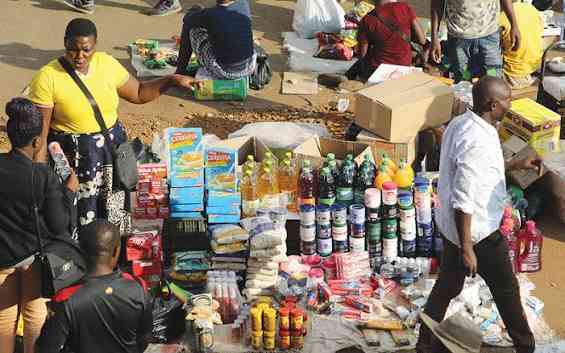
Vendors in Bulawayo have raised concern over the government’s new 6pm trading deadline for central business districts, saying the restriction could result in lost customers, unsold goods and reduced income.
The government announced last Thursday that vendors operating in CBDs across the country’s 92 local authorities must trade between 6am and 6pm, while those operating in residential areas can trade until 8pm.
The new hours took effect immediately.
Local Government and Public Works permanent secretary Tafadzwa Muguti said the measures were part of efforts to regulate vending and improve the management of public spaces.
But traders in Bulawayo said the 6pm deadline could affect business during a period when some customers are returning from work.
MaSibanda, a vendor, said some customers only reached the city centre towards the end of the working day.
“Closing at 6pm will affect us because that is around the time some people are coming from work and looking for something to buy,” MaSibanda said.
“By the time they reach us, we will already be packing up. It means we will lose customers and income.”
- Hwange to institute legal action against defaulters
- Zupco on cusp of collapse
- Spare us the sanctions rant, please!
- Timely disburse devolution funds, govt urged
Keep Reading
She said traders selling fresh produce could also be affected by unsold stock.
Another trader, identified as Mpofini, said some vendors had customers who preferred to shop after work.
“They know where to find us and they come after work, so closing at 6pm means we are shutting them out,” hes said.
“We need to be given an opportunity to trade during the hours when there is still demand.”
Mpofini said traders wanted to operate within an organised system but urged authorities to consider their livelihoods.
“The issue is not that we do not want order in the city,” he said.
“We want to operate properly, but the authorities should also consider the livelihoods of people who depend on trading to support their families.”
MaMhlophe, another vendor, said the new deadline could also inconvenience customers.
“For customers, knocking off from work at 6pm will be difficult because many people finish work late,” she said.
“They may come looking for vegetables, food or other basic things, only to find that the vendors have already closed.”
Bulawayo United Residents Association chairperson Winos Dube said residents understood the need for order, cleanliness and safety but said implementation would be important.
He said closing times alone would not address all the challenges associated with informal trading.
“Simply telling vendors to stop trading at a particular time does not, on its own, address the underlying challenges of waste management, congestion or illegal trading,” Dube said.
“Bulawayo already has designated vending areas and previous efforts to regulate trading have shown that enforcement without adequate trading infrastructure and engagement can simply move the problem elsewhere.”
Dube said authorities needed to consider what would happen to traders after the stipulated closing times.
“If the pavements are clean during the evening, but vending simply moves into undesignated areas, then we have not really solved the problem,” he said.
He called for designated vending spaces with supporting infrastructure.
“If the restrictions are accompanied by adequate designated vending spaces, refuse collection, lighting, sanitation facilities, security and consistent enforcement, they could contribute to better management of public spaces,” Dube said.
Dube also said the new hours could affect residents who shop from informal traders after work.
“Many working residents only return home after 5pm and depend on informal traders for fresh vegetables, cooked food, fruit, clothing and other household necessities,” he said.
Emakhandeni-Luveve legislator Discent Collins Bajila said the government should instead be looking at expanding economic activity.
“The government should be planning to convert Zimbabwe into a 24-hour economy,” Bajila said.
“We can’t reach an upper middle income society by forcibly reducing people’s productive hours.”
He called for the establishment of dedicated spaces where informal traders could operate.
A Bulawayo-based analyst, however, said informal trading needed defined operating hours.
“Vending is trading. It must have operating hours, just like any other business. Vending is out of hand, and letting it go for 24 hours makes it worse,” the analyst said.
“Trading must be licenced, regulated, orderly. What is obtaining now is not benefitting the country.”
The new restrictions come as Bulawayo continues to deal with a decline in formal industrial employment.
A 2022 Bulawayo City Council survey showed that employment in the city’s industrial area had fallen from about 40 112 workers in 1989 to approximately 8 000.